Showing posts with label Future. Show all posts

Monday, September 9, 2024

Foundation by Isaac Asimov, a philosophical discussion

The Foundation book used in a philosophy class.

Foundation Series by Asimov

My daughter headed off to University this September and signed up for that polarizing class of Philosophy. Just like Accounting 101 or Creative Writing for the non-creative, the topic of Philosophy is one of those subjects you either love or hate. No middle ground, and I'm going to stand firm on that statement.

Anyway, I looked over her booklist and cringed at the names. Plato, Socrates, Hercules...all the classics. Those heavily annotated, footnoted, translated, and still impossible to read, writings by toga wearing Greeks. 

BUT, a big but, then I saw a title and author that brought light to my heart - Foundation by Isaac Asimov. WTF? Foundation is a philosophy book?!

Is Foundation a sci-fi book or a philosophy book?

No, no, no. Foundation is not one of those fancy-dancy high browed thinker books. It's a sci-fi story of a galactic empire collapsing and being built up again. There are no deep quotes that can describe the book like, "Men are disturbed not by things but by the principles and notions which they form concerning things" (Epictetus). Nope, it's a book that is actually fun to read (Philosophy is roasted!). Foundation is not something that I would shelve under Philosophy. If anything I would put it under 'Space Opera'.

Am I missing something?

I reread the book with a different mindset. I did my best thinking man pose, put on my ancient Greek philosopher toga, grabbed some wine and grapes, and settled into a public bath with my old paper copy of Foundation.

Holy crap, there were a lot of philosophical questions raised in this book.

One overwhelming idea is about nation/empire cycles. Are we destined to always repeat the same rise and fall of nations? Is appears that Asimov thinks so. Foundation takes place thousands and thousands of years in the future, and we are still doing the boom and bust of nations - just in the future it is on a galactic scale.

This reminds me of another book I read recently: Ray Dalio's best seller - The Changing World Order : Why Nations Succeed and Fail 

Dalio's book explains how nations rise up, build empires, rule the world...then fail. Time and time again from the Romans, through the British Empire, to the United States of today, nations have followed very similar paths. His theory relies on historical data and human psychology.

In the Foundation book Asimov shows us a galactic empire following this rise and fall pattern. The Ray Dalio of the book is named Hari Seldon and he uses the new science of Psychohistory (a mix of psychology and history...see the connection?) to bring everything down to a mathematical equation - and the equation shows a galactic collapse is imminent. Seldon uses this new science to come up with a plan to save humanity from 30,000 years of dark times to rebuild, and cut that rebuilt time to only 1,000 years. 

This brings up that great philosophical discussion on free will and determinism. If we as humans keep repeating this cycle over and over again, do we actually have free will?

According to Dalio's theory and Asimov's Foundation story, we might not have as much free will as we want to believe we have. The future is already marked out for us. Maybe not exact down to the minute dates and times. We can't say exactly when a nation/empire will fail, but we can say that at some point in one hundred years it will. That's just the nature of human beings.

In Foundation Hari Seldon uses his Psychohistory to predict the future. Throughout the book, time and time again, it drives home the point that that the future is predetermined. In fact, some of the ways out of the many crisis points is to do nothing at all. Is this book saying in the grand scheme of things we have no free will, no impact, on the destiny of human kind? 

That's something to discuss in Philosophy class.

Geez, I guess I missed the mark on this book when I read it the first time. I just took it on the surface, as a sci-fi story about rebuilding human civilization in the far distant future, not a book about free will and determinism as a species!

Monday, April 25, 2022

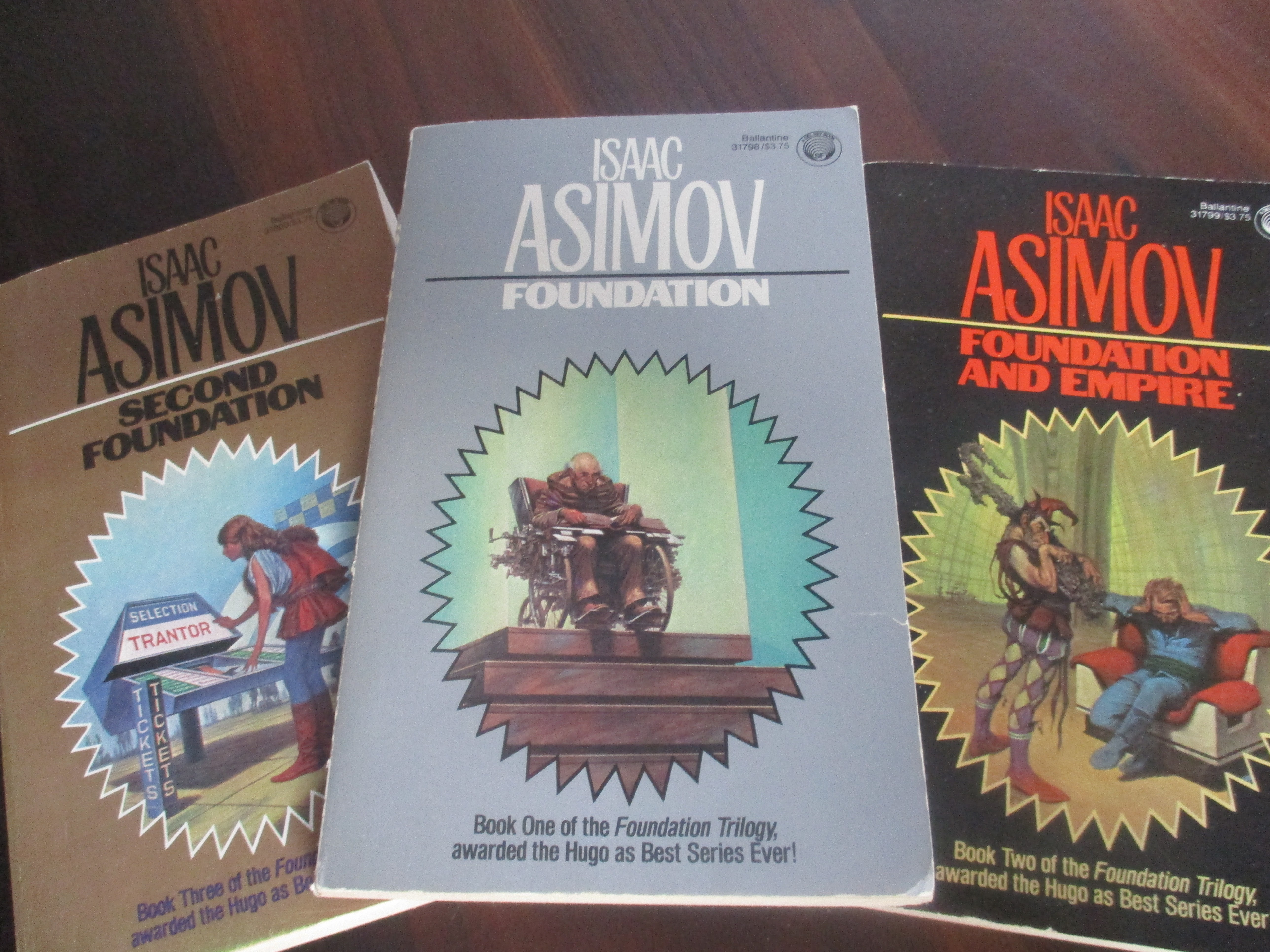
The Foundation Trilogy - Isaac Asimov

 The Foundation Trilogy

Asimov's Foundation Trilogy

Isaac Asimov

I mentioned in an earlier book haul post that I found these three books, all at one time, and they were only 50 cents each! You would have snatch them up if you had seen them, right?

So, I finished reading these books and was struck by two big things. 

ONE - The overall idea of the Foundation is still believable, and seems even more obtainable now ,than it was when the book was first written in the 1950s.

TWO - Even though there is absolutely no action (as in space ship shootouts, or laser beam murders), and the book is mostly dialogue and big-thinking ideas...I was still enraptured by the storyline and couldn't put the books down.

Foundation

Let's take a look a my two finding shall we?

A) The big idea in the Foundation books was that a brilliant man, Hari Seldon, uses math and probability to predict the future of the entire galaxy. Back in the 50's they barely had calculators, so it was a futuristic idea that humans would ever be able to crunch 'big data' and use it to tell the future. Now 'big data' is a term everyone knows about. The more data we have, the more accurate we can predict things...well, Foundation is built on that concept. The idea that we colonize space and our population balloons in the the ca-billions, and as humans we all act very similar, there is a logical conclusion that we can predict the future.

Foundation and Empire

B) Nothing called 'action' or 'adventure' happens in these books. Add that with the whole premise of math being the idea behind foundation and you've got yourself a very boring sounding book. But, somehow Asimov makes it interesting. I can't put my finger on why the actionless story kept my attention and consumed my reading hours. It wasn't flowery writing, or anything like that. If I had to take a stab at it, I'd say it was the set up and twist routine that Asimov uses over and over. The stories usually started in the middle of some sort of crisis. Be it political, theoretical, economical, militaristic. They all had what looked like a straight forward ending or answer (usually involving the Foundation being destroyed), but right at the end there would be a twist and all would end up well. Sounds simple, but I'm doing a terrible job at describing it.

Second Foundation

If you haven't read these books you need to. Especially if you call yourself a sci-fi reader. Check out the link below to get your copy today!


Friday, April 16, 2021

THE RUNNING MAN - STEPHEN KING

 THE RUNNING MAN

THE RUNNING MAN - Stephen King aka Richard Bachman

- Stephen King

Wow, what a ride!

The aptly named book kept me running, er flipping through the pages like I was running a marathon. Essentially the story is about a man who is a contestant on a gameshow where he is set loose and the world hunts him down. There are roadblocks after roadblocks that this man overcomes. He uses disguises, help from others, trickery, and sometimes firepower (aka guns). The great writing by King makes the chase, which is half the book, not seem repetitive. He does a great job of mixing in luck, brainpower, the unknown, and full out sprinting action to keep things fresh, and to keep me reading late into the night. 

The main character is a dodgy fellow who is selfish, crude, and very very (very) anti-authority. But, he is also smart, possibly good hearted deep down inside, and brave. So a good mix of good and bad. At times you want to hate him, but you are always rooting for him to win. An interesting dynamic.

I will say that the movie had Arnold as the main character - um, the book described a scruffy, emaciated, poverty stricken man...not buff Arnold in a speedo suit!

Arnold in The Running Man

What I think is neat is that King wrote this book in the early 80s, well before the advent of Reality TV. However, this idea of taking a regular person, playing a giant game of hide and seek, putting it on TV would have seemed far out there at the time, but nowadays it is so common you might even reject the idea as 'another one of those Reality TV shows'. Now, we wouldn't be hunting down and encouraging death and killing, but the idea is similar. Isn't it?!

I wonder if this book inspired others like The Hunger Games? A good bookclub question eh?

Book Club meme


Tuesday, July 30, 2013

THE WINDUP GIRL

THE WINDUP GIRL


- Paolo Bacigalupi -

I've been meaning to read this book for about two years now. It was one of those highly acclaimed, sci-fi, Hugo award winning, much talked about books that 'everyone' needs to read. Which was why it was on my radar. This month is dystopian novel challenge month, which is my real motivation for finally getting around to cracking this one open. And, I have to say it is not a book that 'everyone' has to read. It is one of those books you will either love or hate.
Set in the near future the world is a wreck, mostly because of genetically modified foods and the genetically modified viruses that destroy that food. It is a tough look at corporate greed and the potential disasters we could face if the food scientist go too far. We have a contrasting crowd of characters from questionable corporate men, corrupt politicians, zealous military officers, slum dogs, illegal immigrants, to the 'windup girl' (a genetically modified test tube baby).
I have read a lot of this genre, the dystopian type book, and I have to say this one did feel original. Not your typical post apocalyptic journey through wasteland or an overly aggressive government who's mustached face is all up your face. The difference was subtle. Perhaps it was the writing style, how the differences between our real world and this futuristic dystopian world were told through examples in the storylines. There was no one thing in particular that I can pull from this novel, just the general feel I guess?
One thing I was not impressed with was the entire storyline. It didn't go anywhere. Actually that is not true, the storyline did a complete loop of the block. Started with a corrupt government, turned the corner with a revolution, came back to the original corrupt government situations and put it in park. It was a bit of a journey, but, nothing too mindblowing. Which surprised me since this book was a Hugo award winner.
On a bit of an aside note (more like rant) I haven't been impressed with any 'award' winning book that I have read in the past couple of years. You'd think if a book won an award it would be outstanding. But, I'm beginning to realize that is not the case. If a book wins an award that seems to mean only that the book is not terrible.
Another problem I had was the setting. Set in Thailand was a big downfall for me. I have very little knowledge of the country, it's people, the culture, even the geography. Paolo did a fair job of explaining the flooding problems, the neighboring countries, and the religion issues when needed. But, I didn't feel drawn into the setting at all. Which makes me think if it had been set on another planet or fantasy world it would have felt more real, had a bigger impact on me. Instead of leaving me half guessing and hoping for more.
So, a bit of a downer review I realize. But, I just didn't get the warm and fuzzies from this dystopian type book. Yes, that implies I do get the warm and fuzzies from other equally sad and scary tales. Again, the book was ok it just didn't meet my expectations.

RATING : DO NOT READ

Thursday, December 8, 2011

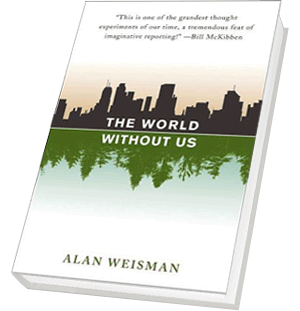
The World Without Us

THE WORLD WITHOUT US


This is a book to make one think. Depending on your point of view the thinking could be positive and hopeful or as uncomfortable as a prostate exam. The question raised is - what would the world be like without us? If all humans just disappeared one day.

The books starts out simple enough, looking at common things like what would happen to your house, the street out front, the park down the road. Well, your house would rot; shingles give out in the first decade, the roof caves in, the walls rot and fall, the basement eventually fills in with debris and dirt. Within a couple of hundred years your house, heck the whole neighborhood, is a mound a dirt beneath the canopy of some mature forest. Weisman then takes us on a journey through New York city. You'd think this big 'concrete jungle' would never fall down, or when it did it would never change back into a natural jungle. Well, it turns out that might happen faster than you'd think. Mostly because the island New York was a swamp at one point, but, we've covered over it. This water will do some nasty damage to building foundations really really quickly and take down even the tallest structures. That is positive to me, in a strange sounding way. It gives me hope that we haven't completely trashed the earth and it could rebuild itself if given the chance.

Then comes the rest of the book. A closer look at what we would leave behind if we all just took off into space, or died out from a deadly virus, or got so addicted to reading blogs on books that we forgot to eat and all died. What we'd leave behind is scary. The ever popular climate change, a few hundred nuclear reactors, plastic plastic and more plastic, and various other hazardous chemicals. Some of these 'problems', like nuclear reactors, are safe right now because we have people keeping an eye on them. But, with people gone these things would eventually blow up and melt-down. And, apparently plastic never fully breaks down - there is no organism that will eat it (notch that up as a victory for mankind). What a legacy.

I found this book very accessible. There was no tech talk, just plain old english used. Easy to understand the ideas and theories that Weismen puts forth. What I really liked was when I put the book down...no, that didn't come out right...when I started thinking about my own situation. What would my house look like in ten years if I did nothing to it. What would it look like in ten years if the tree out front blew down in a storm and took out the windows. What would happen the van? Would I be able to come back in fifty years and pick out my washing machine? Oh, so many important questions. Dropping the jokes, I found this book very relevant and easy to relate to.


RATING: READ

Thursday, September 8, 2011

Mockingjay

MOCKINGJAY


- Suzanne Collins -


A good end to the trilogy. Everything was all wrapped up like a nice little burrito...but, a burrito lacking spice. I had high expectations for the end, but, I always do in with these long drawn out book series/trilogies/epics. Endings never seem to make me happy. The rest of the book was pretty good, lots of action, lots of unexpected twists, but the biggest surprise right at the end fell a bit flat for me. Also, Katniss seemed to lose her fiery character which, to me, turned her from the star of the show to an almost mediocre character.

I did find this book, and the series in general, very imaginative. The strange scenarios and even stranger 'weapons' that appear make for good reading. The supporting cast of Peeta, Haymitch, and Gale add some much needed depth to the story. I liked how their personalities were a nice mix of quirky, extreme, and realistic. The rest of the world of Panem was very well described, I thought. It was really easy to become immersed in this possible future of mankind.

Katniss. Hmm, what can I say? I guess, I'll go with her title - The Mockingjay. By the end of the third book she had become just that - a copy cat with no personality! The change in her character over the trilogy was drastic. She went from a self determined fighter to a push over. The epilogue was the icing on the cake, when it mentioned she had a couple of kids b/c her partner (I won't spoil it and tell you who) wanted them. She was so adamant about not having kids in the beginning, and then by the end, boom, pops out a couple?!

Even though I may sound harsh by criticizing the character development, well, that is just my opinion...I guess I just like happier endings. I will give praise to the Collins on the wonderful writing of this drastic change. It was almost too subtle to detect until you look at the big picture. The journey through Katniss' breakdown was interesting, even thought it was often repetitive - with psychological breakdown after psychological breakdown.

The whole 'love story' (blah) was ok, even by my standards. It was very familiar - I kept thinking Team Edward Team Jacob, but in this case Team Gale Team Peetah? So, again left you guessing and wanting to read on to find out the eventual victor.

Another aspect of this book that made it interesting for me was all of the chatter online. It seemed like everyone was reading this series or predicting who would star in the upcoming movie. I found it added another level, outside of reading, to become engaged in the book. I also found myself wondering about the movie...so much so I have a strong opinion on what song should be on the soundtrack. Everytime I hear Sprawl II by Arcade Fire I think of this future world described in the Hunger games. I can see the flashy young kids in the Capitol dancing away to this song.


Overall, this is a good book. It does not compare to the first of the series, The Hunger Games, but it is a must read if you make it through Catching Fire. I don't think you'll be disappointed, per se, but just a little bummed that the ending was not mindblowing!


RATING : READ

Sunday, August 28, 2011

Catching Fire

CATCHING FIRE


What a follow up to The Hunger Games! This series just keeps building up to something huge. Just as in THG (The Hunger Games), there is still that wonderful unexpected feeling that keeps the story exciting. There is also another cliffhanger of an ending...so make sure you have the next book on hand.

The story starts off seamlessly continuing from THG, which you will recall ended when Peeta and Katniss had that 'break up' at the train station. The beginning is rather lackluster, Katniss narrates her confused (somewhat selfish) thoughts for the first fifty pages or so...which I found very slow and near boring. A lot of it was her debating her feelings for Peeta (love story, blah!) In fact, if this were any random book I picked up at the library or garage sale for a quarter I would consider putting it down. But, there was this feeling that something big was on the horizon; there were small clues, a scene with President Snow, and a gradual description of life worsening in Katniss' district. Then the unexpected happens - the victors are thrown back into the arena to duel it out again! Peeta & Katniss are pitted against each other...what are they to do?

Well, as it turns out Katniss' stunt with the berries in the first Hunger Games was the spark needed to ignite a rebellion...hence the title Catching Fire. There is clues and hints that a revolt is starting and there is some sort of underground movement or organization that is looking out for Katniss and Peeta, since they were the ones to strike the match on this whole thing. This comes to light when The Hunger Games start again.

The second time through the game for Katniss is much quicker, only a hundred or two hundred pages. There is less time spent worrying, as they are experienced players now, and more time strategizing. Oh, and they form an alliance this time, which is an interesting twist to the games experience. Again, full of action and excitement and unexpected turns of events. Then a nailbiting ending where the game and the capital are turned on their heads! To be cliche: the world will never be the same again!


RATING: READ

Wednesday, August 24, 2011

The Hunger Games

THE HUNGER GAMES!!!


As I've mentioned, in some earlier posts, I love books about future dystopian societies. I also happen to love watching that ever popular (and frequently repeating) tv show Survivor. How about a mash-up? Survivor set in a future dystopian society? Ah yes, the ultimate mash-up!

That, in a nutshell, is what The Hunger Games are. Just an extreme version of reality tv survival show where instead of getting voted off you are killed off. This kind of storyline could be taken in many directions. There is high potential for some coat tail riding on the reality tv wave (is it still popular?). However, Collins has not taken the easy ride, instead she has created a literary masterpiece. She has the perfect blend of action, mystery, imagination, even (ugh) a half decent love story.

There are so many level to this book. The action is there, the complex complicated love triangle, then all the symbolic names & sayings & mutated animals (which I'm sure all mean something much deeper that will hopefully be revealed as the trilogy goes on...either that or just leave us all guessing). In other words, this book makes you think, even as you are caught up in all of the fast paced action. If there was foreshadowing I missed it, which made me attempt to predict what was going to happen...and to my delight, time after time I was wrong! The unexpected keeps you moving through the book - you want to hurry along to find that next shocking moment where the unpredictable (yet logical) thing happens. The sense of anticipation in this book is great. Collins does a superb job of keep us readers on our toes.

I'm still pondering the deeper meanings and the symbolisms in this book. I'm attempting to work through the names - Katniss, HAYmitch, Thresh, Clove, Rue...all food related. Cinna (singe? cinder?), coal, fire...seems to me a lot of basic surival references - the basics; FIRE, FOOD, WATER? Ah, I'm lost, but in a good way...I feel like I need some Coles notes. Remember those? Now, don't get me started on my mockingjay theories.

The best part of this book...it is only the first in a trilogy. I have two more books to continue on with. I hope they are just as good (b/c I actually bought these books...NEW!). This book left us with a great base to build off of. We have a handful of strong, deep characters that must have some interesting back stories.

If it is any indication of how good the book was - I read it in about 4 days!


RATING: READ


Note - Funny, the last three books I've read (The Book Thief, The Wishsong of Shannara, & The Hunger Games) have all had strong heroines?!


Saturday, January 8, 2011

METATROPOLIS

METATROPOLIS


- John Scalzi -
(Jay Lake, Tobias S. Buckell, Elizabeth Bear, Karl Schroeder)


I saw this book on display at the library on the 'new sci-fi/fantasy books' and ended up taking it out. This was definitely an 'impulse buy', if that is possible to do at the library? I was rushing through picking up something else, on my lunch break, and I just happened to be walking by the 'new books' display (which seems to happen every time I'm there). I was not in need of a book since I was still only halfway through The Bourne Identity, but, I picked this book up anyway. Just to glance at it of course. What interested me was the self labelling on the front cover - A collection of stores in a shared future...yes, now seeing that in print I realize it's a bit weird to find that interesting. But, I really like books that take a look at the world in the near future, especially those horribly depressing post apocalyptic ones!
Looking this book over I realized this book had a couple of things against it, at least in my eyes. One, it was not a book about a post apocalyptic world, which I initially thought it was because of the cover art. Two, it is a collection of short stories...I don't typically read collections of short stories, I prefer the long drawn out epic trilogies of at least 1800 pages. Even though I think I prefer epics, the two books of shorts stories I have read in the past have stuck with me, and I enjoyed them and I think about them from time to time. Anyway, I gave into my impulse to 'impulse buy' and borrowed the book.

The five stories are all good enough to be stand alone short stories, but, together they create something more. The writers all do a great job of interlacing their individual stories with all of the other ones in the book. For eg. there is a constant contracted security force called Edgewater that makes an appearance in each story. Many of the new gadgets of the future make their way into multiple stories (like the 3D glasses). There is also mention of the other stories and cities the other writers use. These all help congeal the book, bringing it all together like a nice jam. One story is like the sugar, another like the strawberries...although good on their own when mixed together to make they can make much more...like a nice jam, mmm.
I know the question you are asking, which story was the pectin - not tasty, but, needed to hold the mixture together?


Even though the stories all revolve around a similar future world and have a focus on exploring what cities will be like, all of the stories have drastically different feels. The major difference is the writing. All of these writers have different styles and putting them back to back really shows this off. I have to say Jay Lake's writing style; straight forward, very simple, short sentences, small paragraphs, was a the one I enjoyed reading the best. This was the first story in the book, so it grabbed my interest and created that positive feeling right off the bat encouraging me to keep turning those pages. I'm glad the book started with that story.


The first story, In The Forest Of The Night, took a look at a city built by environmentalists. Imagine how a city of extreme 'tree huggers' would look, function, and survive. Well, Jay Lake, thinks it would be found in the deep forests on the Pacific west coast. It would be hard to find since the citizens would be very conscious of the land and do all they can to prevent harming it. These people would be spread out, and very little government would exist. They would be self sufficient and eat fungus and stuff they grew in the trees (yum). It kind of reminds me of the many fantasy books I've read and the elves. Elves have cities in the forest, that blend right in. They somehow keep in balance with nature and cause no ill effects.


The next story, Stochasti-City, by Tobias S. Buckell, looks at how Detroit might fare in the future. With sky rocketing oil prices and a ruined economy, it seem many people are getting desperate for jobs. 'Turked', is the key word here. Turked, is taking a small job that is posted on the web, some job like - take this unmarked bag to a corner three blocks from here and drop it in the mail box. Obviously some illegal smuggling or something, but, when there is no work people get desperate. The main character takes one of these 'turked' jobs, which is to watch a security compound and text a message everytime the security officers come out. He ends up not getting paid so he tracks down the people who were supposed to pay him. Turns out it is a gang of bikers, not motor bikes (what with the cost of oil and all), but bicycle riders. Who are also extreme environmental activists. They take over abandoned skyscrapers and turn them into farms/greenhouses. They travel across the country doing this. I guess this appeals to the main character and he ends up joining them and has a much more fullfilling life. No more 'turking'.

The third story, The Red In The Sky Is Our Blood, Elizabeth Bear, is also set in Detroit. It is another story with a bicycle. A hardened biker chick is recruited by a secret society (I guess the another idea of an alternate city of sorts) who live in the former suburbs. All of the houses are abandoned, so this secret society salvages stuff to make them into greenhouses. This book has the feeling of a public service announcement/survival guide. It talks all about how landfills are filled with so much stuff that if we scavenged it all out we could live a mighty fine life, and lack nothing. I found it kind of preachy and the story line was lacking...even for a short story. If I were grading this I'd give it a D- . Which is kind of sad b/c I've read Elizabeth Bear novels and liked them.
This story may be the pectin I was talking about earlier.

The fourth story, Utere Nihil Non Extra Quiritationem Suis, by the editor John Scalzi, is a bit of a lighter story. It starts and ends with a pig in a wedding picture. This one takes place inside a new St. Louis. It's a closed city where the economy strictly managed. The main character is a slacker who finally comes of age where he either has to work or leave the relative safety of the new city. However, since he waited so long and never took school seriously he is left with a position working in a skyscraper pig farm. Lucky guy!
In the end he goes from a kid on the edge of society, not connected and not involved, to find his place in society. This one had a slightly more positive look at how efficient cities could be in the future...even if they are surrounded by chaos.

Final story, To Hie From Far Cilenia, by Karl Schroeder, is the only story that takes a peek into a far flung idea for a future city. The idea is a virtual city 'made' from online gamers. It sounds like they put on these special glasses that change the way the world looks. Buildings are given an old world feel, people's clothes have the look of the early 20th century, and other's with the glasses in the same world are highlighted. It sounds like the more you put into this world the more access you get, and eventually can move onto deeper and deeper worlds. They are hidden cities, functioning apart from 'reality'. There are restaurants only members can get it, with food grown by other 'members', all living in buildings for 'members' only. Very complex...in fact, a little too complex for me to really follow. This may have been better in novel length?

What was missing for me...a future city on the moon!

Overall, I felt kind of depressed reading these prophecies of our future. Where has the happiness gone? Where was the hope of a brighter future? Where has the dream of space travel gone? Maybe I'll look for a brighter book on my next visit to the library.

Rating: READ