Wednesday, November 28, 2012

THE DAYBREAKERS

THE DAYBREAKERS
(Sacketts #6)


Another classic Western story where a tough kid from the East brings justice to a fledgling town in the wild West. Apparently, this is number six in a series, yet it felt like both a stand alone novel or the beginning of an epic series. It starts at the beginning (haha), when two brothers, Tyrel and Orrin Sackett, take off to the open country of the West. They face a pile of obstacles; natives, roughnecks, gamblers, drunks, land grabbers...all the common villain types. They end up settling in a small town and start rachin'. From there the two brothers build different lives; Orrin goes into politics, Tye becomes town Sheriff. From there, the big trouble begins. Orrin marries into a family that turns out to be pretty nasty and Tye, as Sheriff, has to shoot down a few people. The ending leaves us with a safe town free of any 'bad guys'. Yet, both brothers have some unfinished business with Orrin's former wife and Father-in-law. As a spoiler, I know this feud between the Sacketts and the Pritts continues on for many books.
Looking over reviews of this book it becomes pretty apparent that readers both love Louis L'Amour and this particular book. There seems to be a read admiration for Tyrel as well. To me, he just seems like all the other good-hearted cowboys in these books. It's interesting to see what motivated people to read this book. Some by accident, some recommended, some because their Father or Grandfather read these books. Many seem to have the same reaction I have, that they really enjoy this genre, even though they'd never consider reading them before. Very interesting.
This particular book I read in LARGE-PRINT format. It was one of the many books I picked up at the box of books for $5 auction. Glad I picked it up. Next year I know to not just glance over the Western section, but, scoop it up!

RATING: READ

Monday, November 19, 2012

WESTERNS

WESTERNS


I have another literary secret that I'm finally admitting to, besides my periodic chick-lit reads, I love Westerns! 
Where else can a guy go to get a taste of cowboy life? A life where one lives on a horse, shoots up bad folk, and can take a bullet (or four) and still live to tell about it. Not only that, but these guys are flawless in a social sense. Their morals are always good, they have great manners, and they appreciate the environment. What more could you want in a character? Maybe a handlebar mustache? Well, sometimes they do sport a nice 'stash.
The storylines in these books, although sometimes predictable, are always full of action and adventure - hence, the 'take a bullet (or four) and still live to tell about it'.
My interest in this genre started earlier this year when I read Stands a Ranger. It was classic. A ranger comes into a dusty desert town and solves a few problems with the local black hats. There were countless shootouts, a saloon fight, and the ranger managed to do it all after being shot a handful of times. In the end the good guys won, hooray!
Recently, I've been listening to Louis L'Amour stories. The Lonely Men was another classic. A lone cowboy, with outstanding morals, saves a bunch of kids from the Natives. Again, countless shootouts, a saloon fight, and a bullet wound that would have killed any other man.  
Both of these stories also featured a strong woman character - who happen to shoot shotguns!  Very progressive in my opinion.
I know it is cheesey, but, I love when the Cowboy/Ranger can take on a pack of five ruffians, shoot them all with pinpoint accuracy, while they only manage to hit the dirt (or maybe a hat) with their bullets. How can you not love a talented man like that? Don't you just want to walk a mile in his boots, wear his hat, sport some chaps...ok, too far.
Although, I do wonder how to justify the hundreds upon hundreds of people these cowboys kill. Yes, they may be 'bad guys', but, how much blood can one hero draw before it's too much? That is the question I leave you with today...

Wednesday, November 14, 2012

I KNOW I AM, BUT WHAT ARE YOU?

I KNOW I AM, BUT WHAT ARE YOU?


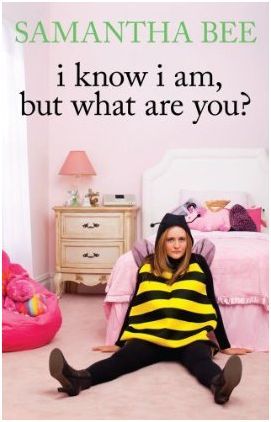
What a ride (that was both praise...and shock). Samantha puts down some of the more memorable and humorous moments of her life in this biography of sorts. We start with her childhood - that explains a lot. Then onto her rebellious teen years. Her short stint in crime. Onto an animal story. Her experiences with the male organ. Then a giant rant about putting in some thought when giving a present.
The writing is overly wordy, filled with funny pop references, packed with sexual jokery, and is constantly off topic. But, done very well for that kind of writing. It's the kind of writing that makes you pay attention, in order to get the references and the word play, it sucks you in and takes you away from reality. You are vacuumed (hoovered up) into Samantha's book world and left feeling a bit shocked but in a good mood.
She starts the book off with a few classic Canadian childhood memories. Like going camping or tagging along with a couple while they honeymoon on the East Coast (including taking over their motel room when it rained - and it rained a lot). The Canadian experience continues when Sam starts to date a boy whose family, recently immigrated to Canada, does not approve of her and her Canadian ways. With this boy she helps commit car theft. Ah, true northern spirit. Then onto those awkward feathered hair years trying to catch older boys at heavy metals concerts and county fairs. We've all been there eh? Then the early adult experience of trying to live with roommates. Sam-wiched in with these stories are Sam's recollections of family pets, all shapes and sizes - there were many. As well, she often has a good side story on the more risk-eh? topics to add in the mix. So, overall very funny, very interesting, and could be considered a great Canadian work of literature...in some parts of the country (I'm thinking way way up North).

Rating: Read

Additional note: The cover is also appealing to children. They like bees. Or, people dressed as bees.

Wednesday, November 7, 2012

THE BEST LAID PLANS

THE BEST LAID PLANS


Finally, a book with a Caucus joke. I'm amazed this word is not used more often. I frequently find myself giggling when I'm listening to the radio and hear this word used in a serious news cast. Eg. Today the Prime Minister met with his Caucus to discuss potential problems with the recent low inflation rates. The Best Laid Plans has a Caucus joke (or two) and many more play on words with all that political jargon we often hear. There is also talk of chess, hovercrafts, and the Liberal Party of Canada...all funny topics on their own, but, mashed together by Fallis they become a hilarious story all Canadians need to read.
This is a satirical look into the inner workings of Canadian politics. It starts with Daniel, a burnt out political aid who leaves the Liberal party with one small favour asked of him - to find and run a candidate in a small rural riding. The problem: this riding has almost no Liberal support, let alone candidates, and has been won year after year by one of the most popular Conservative members of all time. 
The impossible begins.
Through some hard work and compromise a reluctant candidate is found (with a promise of not winning) and two unorthodox looking volunteers are reigned in to help run the election campaign. After a few unforeseen twists the impossible happens.
The story then shifts to the inner workings of our nation's capital, showing us many of the flaws inherent in our Parliamentary system, the flaws in many members, and the flaws of a Caucus. The newly elected member turns into a kind of lovable maverick who bucks tradition and acts in a way we would love all of our politicians to act - in the country's best interest with no regard for reelection.
You do not have to be a political buff to appreciate the story or jokes in this book and you don't have to even be Canadian to enjoy the story - although it does help a little. The writing by Fallis is easy to get into and easy to relate to. Most of the funny situations that arise transcend the political world and could just as easily happen in an office, any kind of community council, heck even a bookclub setting. It just seems to be that little bit funnier when it takes place with the leaders of our country, and a little bit scarier too. The characters, for the most part, are believable and lovable...especially that Maverick McLintock, who is the classic hard shelled grump with a soft chewy interior that you just want to eat up after you get to know him. Mmm.

RATING: READ

GUARDS! GUARDS!

GUARDS! GUARDS!


We get to meet the Night Watch in this 8th Discworld novel by Pratchett. You gotta love a ragtag bunch of losers who have no recognizable talents and put no effort into their jobs whatsoever, yet, somehow seem to come out on top. This is the kind of situations that bring out the best in a character...or at least makes them memorable. Carrot, Knobbly (sic), Colon, and the other guy are now etched into that happy spot in my brain.
This toasty offering is just bubbling with laughs. Not only do we have the incompetent Night Watch, but there is a Crazy cat lady...er, Crazy dragon lady, a hilarious bunch of argumentative 'brothers', an angry librarian ape, and a dragon in heat. Image the story you can forge with all those characters.
I rank it up there as one of the better Discworlds I have read so far. 

Funny, as with some of the previous Discworld novels, I can barely recall the actual story line(s). What I vividly recall is a patchwork of funny scenes or one of the hilarious discussions/arguments. The book leaves me with more of a feeling than a distinct memory. A good, funny, happy feeling. Strange...

RATING: READ

P.S. Think Carrot top.

Monday, October 29, 2012

I'VE GOT YOUR NUMBER

I'VE GOT YOUR NUMBER
(Chic-lit secret read #8)


Again my theory on Kinsella proves true. This book sat on satire and now has to run home and change! It's that bad...er, good. It is a powerful look at how deep cell phones (mobile phones for you English Englanders) have invaded our lives, how much control they have over people's behaviours, and even how they effect love lives!
There are many lines in the book that really drive home how personal cell phones are to some people. When Poppy loses her phone she says something along the lines of, "I feel like I've lost my life". Later on in the novel when she has the phone, with all her contacts and messages, she says the feeling of it in her hand is 'comforting'. Another example is when a computer tech realizes two people have been 'sharing' a phone he is shocked and calls them 'sick'. Wow, for a person such as myself that does not even own a cell phone I feel like I am missing out on a whole new world. I bet it is the same for those who are blogless, and do not know the rush of seeing your hit count rise or the ultimate enjoyment of seeing comments!
Back to the book now. The story really begins when Poppy loses her cell phone. She is so desperate to remain in contact with the world, for a variety of reasons mostly to do with her upcoming wedding and a missing engagement ring, that she ends up using a phone she finds in a garbage can. Yes, I realize this sounds outrageous and a too far fetched even for chick-lit, but, Kinsella's writing (and slightly crazed characters) make this seem believable. 
It turns out this phone is from the personal assistant of a rich, extremely successful, slightly handsome, emotionally fraught, guy named Sam. Sam is one of those people who is so busy, from all his success, that he leaves most of his life with his personal assistant. Therefore, the phone is chock-full-o-info on this guys life.
Poppy ends up making a deal with Sam that allows her to use this phone for just a couple of days and in exchange she is to forward all messages and emails onto Sam. After a day or two Poppy becomes deeply involved in Sam's life, both his personal life and professional life, thanks to all of the messages on this phone...which she was not supposed to read, but, did to burn time while riding the Tube. Since she doesn't know the entire story, or Sam on any sort of real life level, she starts to make assumptions and acts on them - replying to messages, setting up appointments...trying in her own way to be helpful. Of course these all backfire and make for some good laughs.
As you may well predict, one of those unspoken lovey dovey relationships starts to build. One that can't work because Sam is emotionless and Poppy is engaged. The difference with this one is that it climaxes over text messages. How modern eh?
I will not ruin the ending, but, will only say there are a few twists that make it interesting. 

I really enjoyed the use of text messages in this book - Short. Right to the point. Smiley Face :) conversations gave the book a unique feeling. Near the end of the book the phone needed to be wiped clean, and the tech guys managed to print up all the messages that were sent. When a novel sized stack of paper showing all of the messages Poppy and Sam exchanged it was as if their own personal love story were made into a paperback. Neat idea...and in a satirical way, showed the extreme overuse of text messaging by heavy users.

I listened to the audiobook of this and was very happy with the reader - Jayne Entwistle. Her voice matched the character of Poppy perfectly. Her voice was very chipper and you could just see her reading into a microphone with a great big smile plastered across her face. I was surprised to find out she was Canadian (or at least lived in Canada for a good chunk of her life) because, she narrated the book with a heavy British accent.

RATING: READ

Thursday, October 25, 2012

WORLD WAR Z

WORLD WAR Z
An Oral History of the Zombie War


Now I get the whole zombie craze. Now I get the questions posted in forums and on facebook status updates asking how you'd fight off a zombie? Or your preferred weapon to decap a zombie? You know the questions I'm referring to?
Part end of the world story and part zombie horror flick, this book is hard to label. It is structured like a historical textbook, looking back at WWZ or the world war against the zombies. There are facts and timelines, but mostly interviews with survivors. It was so well done I almost felt like I was reading (or in my case listening to) a true, researched, fact checked, non-fiction. Maybe even as additional reading for a history 408 class at a local college, or something. It was so good it gave me the creeps...and a slightly restless night.
What made me think it was real was the beginning. The zombies start appearing like a sickness or plague. Nobody seems to take it that seriously. Which makes sense. What government or news media is going to take stories of the undead walking around infecting people in rural China seriously? But, then when they finally do, it's too late. The plague spreads too fast to control and before you know it there are cases around the entire world.
Through the interviews we get an idea of how different places dealt with the zombies, how zombies behaved, how they could be killed, why they moaned...you get an almost scientific look into zombies. We also get many views of how the plague spread, what the world was like when it peaked, and how the survivors banned together to eventually win the war against them.
If you enjoy apocalypse books like The Postman or The Road you'll like this one. There was gruesome accounts of zombies eating guts and sick stuff like that, but, mostly the writing was about how the world changed and how the survivors were dealing with this new world.
I listened to the audiobook and have to say I think it could be better than the written one. Since the set up of the book is mostly interviews the audiobook has different voices for the different characters. That bumped it up a notch making it feel genuine and real. It felt like I was listening to the audio of a documentary.
Before hearing this book I had no knowledge of zombies, other than they make a good halloween costume, but now I feel educated. Yes, educated. One should know a bit about zombies...just in case.

Rating: READ

Friday, October 12, 2012

FOOD AND THE CITY

FOOD AND THE CITY
Urban Agriculture and the New Food Revolution!


Where is my hoe? I need it now! I want to rush out into the streets and start planting beans, tomatoes, apple trees. Literally, right on the street!
That is the conversation I had going on in my head after finishing this book.
Cockrall-King lays out her new food revolution theory. It's not an instruction manual, or a slogan filled rant, but a well researched look at examples of urban agriculture throughout the world and why it may be essential in the future. It was an eye opening look at all of the different ways we can grow food, not just on a farm outside of the city limits. For a backyard gardener like myself this was inspiring.
Jennifer's argument throughout the book was easy to follow and pretty common sense - that right now, our food system is fueled by oil (fertilizers, tractors, distribution, etc), but, if we are at 'peak' oil what will we have to do in the future? When oil becomes more expensive the cost of food will rise, until at some point it will not be affordable to continue with the current system. She points out that we will need a different way of growing food, a more sustainable way that does not rely on oil. Then she gives us a few examples from around the world and close to home here in the frosty north.
All of her examples stressed local food. Bringing food closer to the consumer seems to be a necessity, since shipping food thousands of kilometers is not sustainable. Different ways of growing food in cold weather was another repetitive topic. Also, integrating the growing of food, not just the eating of it, into our cities and everyday life crept up in most of the examples too.

It was interesting hearing about how other countries have unique ways of dealing with urban farming. I really liked the trip to Paris.
Paris. Ah, those foodie French! Not only are they the experts on cooking, but, apparently the experts on urban farming. Right in the heart of the densely packed city there are stone walled gardens that have been spitting out salad greens, tomatoes, fruits of all kinds (even in the winter), for hundreds of years. These stone walled enclaves are mini microclimates that hold in enough heat to keep producing all year round. Fruit trees are grown and pruned to hug the wall, grabbing all that stored heat, and producing fruit for a much longer time than if in an open orchard out in the countryside. In the winter these plots are the only ones supplying fresh produce, which means they can charge a premium price. This is what has made the system sustainable for so long and will keep it going for years to come.
Another example, that I was vaguely familiar with, was the situation in Cuba.
Cuba. This is the example held up to the world to show that urban agriculture (organic to boot) can work. Cuba was farming the same way as everyone else - using oil for pesticides, fertilizers, to run tractors, and distribute from the countryside to the city. Then the Soviet union collapsed. The US imposed an ultra tough trade embargo. And, well, Cuba is rather poor. So, they lost their oil and had to find another way to feed their people. They had to overhaul their entire way food was produced and distributed. Intensive urban farming was the solution. Tracts of land, right in cities, are set aside and intensively farmed. Produce is sold right from a stall at the end of the 'field' direct to the consumers. There are almost no grocery stores now, and much of the food the people eat is grown right down the street.
Along with the positives, there were a few negative stories. LA was one of them.
LA, USA. Gang ridden, run down South Central LA is full of abandoned industrial sites that leave a nasty blight on the city. The area is a food desert - no grocery stores with fresh produce for miles and miles. A new 'union' of farmers, mostly immigrants from Central American countries, living in the area take over these sites and build community gardens to grow fresh vegetables for themselves. They take back these asphalt covered garbage dumps and make them productive and lively. However, after these places are built up and attractive again, the old owners come and take them back...with the help of the law. It's one of those infuriating stories you hate to hear about.
In the frozen land of the north here, Jennifer shows us how far behind we are. She shows us many great ideas, but, sadly they all seemed to be isolated one-off situations.
Canada. Jennifer did some travelling across Canada and wrote about a few novel ideas she came across. Public orchards was one I found interesting, and left wondering why all cities don't plant a few apple trees here and there? Same as an idea for the food bank to go around and pick fruit from trees on private property (with permission of course). The most interesting idea was one 'farmer' who swapped the use of people's lawns for vegetables. The ideas is this guy would use your lawn as a garden and give you a half or a third of what he produced. He then went on and sold the rest at a farmer's market or to local restaurants. The example in the book told of one guy making an actual living wage doing this...it was a lot of work and bike riding to his three or four different lawns/gardens, but, it was possible.

Food and the City sure gives you something to think about. It's inevitable things will be different in the future, but, what can we do now to prepare for that? After reading this I am even more motivated to expand my vegetable garden out back, and change my flowers out front to blueberry bushes. I have even started urban foraging (picking up walnuts from a tree near where I work), and plan on planting some of these walnuts to give my kids (although more likely the squirrels) even more local food to munch on in the future. I plan on suggesting planting apple trees whenever I can (be it in a letter to the city, next time our school plans a new garden, at our annual condo board meeting) or even joining local activist groups that would take over abandoned parking lots and turn them into herb gardens.
But, that is just me. The book may have a different effect on you.

RATING: READ

Wednesday, October 10, 2012

THE RHYTHM OF FAMILY

THE RHYTHM OF FAMILY 
Discovering a Sense of Wonder Through The Seasons


A granola-crunchy wholesome book about connecting you, and your family, with the earth. It is a nice mix of inspiring moments, seasonal activities, and crafts - all focusing on finding that natural rhythm of the ever revolving seasons. The book is split into four parts (spring, summer, fall, winter) and each part follows a similar format - a couple of personal journal type entries by Amanda and Stephen Soule that reflect on the way their family reacts/celebrates each season. Followed by an activity and craft (or a few) that are relevant to the season (making soup, collecting leaves or other naturey things, yoga in the park, etc). 
Reading through this book, like with the other Soulemama books, I am reminded to slow down, smell the roses, and keep life simple. It made me want to continue teaching my kids about trees and plants...and build that mystical bond with earth, the wind, the sky...I know, it sounds a little far fetched, slightly embarrassing, nudist-colony-hippie-type thinking...but, it's true (not the nudist part).
Compared to the other books by Amanda (Soulemama), this one had a different feel and style. I think it was the vastly different writing style of Stephen (Soulepapa). He seemed to take a different perspective on things; almost like taking a step back to get that larger panoramic view. I found his writing style edging on poetic and rather wordy. Amanda's on the other hand felt more personal somehow, and easier to connect with. It was just simple, in an easy going kind of way. It was interesting, in a literary way, to see the different writing styles on the same topics. However, personally I enjoyed reading Amanda better than Stephen (sorry, Stephen).
I would say read the other Soulemama books first (if you haven't), then read through her blog, before getting around to reading this one. But, be sure to put it on your list of must read granola-crunchy wholesome books.

RATING: READ


Wednesday, October 3, 2012

MINI SHOPAHOLIC

MINI SHOPAHOLIC
(#6 in the Shopaholic Series)


- Sophie Kinsella -

I believe this book, and the series, is being marketed under the wrong genre. If you go looking for this book in the bookstore you need look no further than the 'Chic-Lit' table at the front of the store, overflowing with books of similar cover. Usually with witty names and pictures of legs clad with fashionable boots. Books with little substance. Unlike its cousins, whom are full of fluffy relationship stories taking place at say, an ad agency full of houte couture fashionistas drinking Starbucks capp....oh, right, this book does contain similar things. But, there is much more! Really there is.
In reality this book is surprisingly deep. If you change your perspective a bit, it appears to be taking a harsh look at society, with a needle sharp criticism of consumerism. Which is why I believe it is worthy of another label. Kinsella, although she may not have intended for this, is a satirical genius!
Seriously, along with the outrage she elicits through her character's shopping problems she brings out a good laugh. Two things associated with good satire. The ridiculous situations brought up in these books show us, sadly, just how far consumerism / materialism have penetrated some people's lives. And, did I mention they are laugh out loud funny situations?
No part of the book highlights my theory more than the new shopping mall incident. Your typical Becky Bloomwood story, she will soon be telling at a shopaholics anonymous meeting, brought to a new level - she brings in her two year old daughter! First, she makes a deal with Luke not to shop. Then on a trip out she sees that a new shopping mall has been built and there is a grand opening; discounts, gifts, sales sales sales! She cannot resist and makes an excuse to stop. She 'needs' to buy socks for Mini. As soon as they get in the door the purchases start. They are not Becky's buys. No, they are Mini's. Becky has given her an allowance, and let her borrow on her future earnings (to teach her about budgeting). She is apparently in hock for the next twenty two years, but, it was worth it...some real bargains. Then Becky attempts to get Mini to agree to purchase a designer dress that will fit her in twenty years (but, Becky might borrow it for right now, seeing as it would be in her size). It all ends in a tantrum that bans Becky (and Mini) from a store.
Imagine, using your two year old to justify buying a dress - that is how down and out Becky has become in this book. Doesn't that just remind you of some desperate drug addicts worst story? See, change your perspective a bit and this book is deep!
Compared to the other Shopaholic books in the series this seemed funnier and more exciting...same unbelievable ending, but, that's ok sometimes. It had a great mixture of hilarious moments and character building emotional storylines. The majority of the hilarity comes from Becky's justifications for shopping and buying ungodly expensive designer things and from all the white lies she tells to solve problems she runs across. Mini, a typical two year old, has some good moments as well, involving such things as honey sandwiches and accidental e-purchases when she bangs on the laptop (as any two year old is bound to do).
The book was full of all the old characters from previous books in the series, but, there was one storyline that focused on Luke and his Mother. Giving us a bit more depth into both of their characters. Not much development with Becky, but, that's fine with me because I think she is one of the most hilarious characters on paper and I wouldn't want her to change.

RATING: READ

*I listened to this on audiobook. I have to say, it was strange to hear a Brit attempting an American accent.