Sunday, August 28, 2011

Squirrel Seeks Chipmunk

SQUIRREL SEEKS CHIPMUNK


Strange. Funny. Original. It's hard to describe this book the way I want to. While reading it I went from laughing (out loud) to almost vomiting in disgust...what book can do that, all while keeping a light airy feel to it? Overall this is a humourous book that delves into the really dark humour a fair bit. But, the content is just...strange at some points. It kind of reminded me of a mix of Monty Python type humour and some no-name crude stand up comedian who relies on swearing and sextalk to make jokes. So, appealing to all people in some way!?

I found it in the short story section in the library. The book has a strange set up, almost like chapters but almost like short stories. The book is a made up of about a dozen small stories/jokes, some range from a few pages to maybe twenty. They are all quips from different animal's points of view. There are birds, dogs, mice, hippos...and to top it off, there are some illustrations from Ian Falconer (you may know him from the best selling children's series Olivia the pig). The stories/jokes are definitely one's that will stay with you for awhile. They are not easy to retell, say around the water cooler at the office, but they are satisfying jokes to read.

The jokes/stories seemed to favour stereotyping. When read they make you laugh, but, then upon further reflection, I found them almost a jab at humanity - how cruel and awful we can sometimes be.

There was a joke about a black watersnake and a white duck who makes a mistaken racist remark. A faithful dog who is sold out to breed purebreds, but, comes home to his 'wife' everynight. Birds who migrate south and complain about the lazy southern birds. The namesake, a squirrel and chipmunk who cannot date because the parents do not believe in inter-species mixing. These were a few I found laughable.

However, there were many I felt were just strange and didn't leave a good taste in my mouth. The one I found the most disturbing was the sick rat & healthy rat.

The healthy rat is put in a cage with this other rat who has cancer and all these tumors or whatnot. The healthy rat gets on his soap box and rants about how the sick rat should have made healthy choices in life and that cancers and such are a direct result of lifestyle...turns out these rats are in a lab that pumps chemicals into them causing these cancers for research. Anyone order some extreme dark humour? Disturbing in a way, but, so easy to relate to! Turn it around and throw a human in there...how cruel!


RATING: DO NOT READ*


*Unless you want to be left with a strange feeling of disturbed happiness.

Catching Fire

CATCHING FIRE


What a follow up to The Hunger Games! This series just keeps building up to something huge. Just as in THG (The Hunger Games), there is still that wonderful unexpected feeling that keeps the story exciting. There is also another cliffhanger of an ending...so make sure you have the next book on hand.

The story starts off seamlessly continuing from THG, which you will recall ended when Peeta and Katniss had that 'break up' at the train station. The beginning is rather lackluster, Katniss narrates her confused (somewhat selfish) thoughts for the first fifty pages or so...which I found very slow and near boring. A lot of it was her debating her feelings for Peeta (love story, blah!) In fact, if this were any random book I picked up at the library or garage sale for a quarter I would consider putting it down. But, there was this feeling that something big was on the horizon; there were small clues, a scene with President Snow, and a gradual description of life worsening in Katniss' district. Then the unexpected happens - the victors are thrown back into the arena to duel it out again! Peeta & Katniss are pitted against each other...what are they to do?

Well, as it turns out Katniss' stunt with the berries in the first Hunger Games was the spark needed to ignite a rebellion...hence the title Catching Fire. There is clues and hints that a revolt is starting and there is some sort of underground movement or organization that is looking out for Katniss and Peeta, since they were the ones to strike the match on this whole thing. This comes to light when The Hunger Games start again.

The second time through the game for Katniss is much quicker, only a hundred or two hundred pages. There is less time spent worrying, as they are experienced players now, and more time strategizing. Oh, and they form an alliance this time, which is an interesting twist to the games experience. Again, full of action and excitement and unexpected turns of events. Then a nailbiting ending where the game and the capital are turned on their heads! To be cliche: the world will never be the same again!


RATING: READ

Wednesday, August 24, 2011

The Hunger Games

THE HUNGER GAMES!!!


As I've mentioned, in some earlier posts, I love books about future dystopian societies. I also happen to love watching that ever popular (and frequently repeating) tv show Survivor. How about a mash-up? Survivor set in a future dystopian society? Ah yes, the ultimate mash-up!

That, in a nutshell, is what The Hunger Games are. Just an extreme version of reality tv survival show where instead of getting voted off you are killed off. This kind of storyline could be taken in many directions. There is high potential for some coat tail riding on the reality tv wave (is it still popular?). However, Collins has not taken the easy ride, instead she has created a literary masterpiece. She has the perfect blend of action, mystery, imagination, even (ugh) a half decent love story.

There are so many level to this book. The action is there, the complex complicated love triangle, then all the symbolic names & sayings & mutated animals (which I'm sure all mean something much deeper that will hopefully be revealed as the trilogy goes on...either that or just leave us all guessing). In other words, this book makes you think, even as you are caught up in all of the fast paced action. If there was foreshadowing I missed it, which made me attempt to predict what was going to happen...and to my delight, time after time I was wrong! The unexpected keeps you moving through the book - you want to hurry along to find that next shocking moment where the unpredictable (yet logical) thing happens. The sense of anticipation in this book is great. Collins does a superb job of keep us readers on our toes.

I'm still pondering the deeper meanings and the symbolisms in this book. I'm attempting to work through the names - Katniss, HAYmitch, Thresh, Clove, Rue...all food related. Cinna (singe? cinder?), coal, fire...seems to me a lot of basic surival references - the basics; FIRE, FOOD, WATER? Ah, I'm lost, but in a good way...I feel like I need some Coles notes. Remember those? Now, don't get me started on my mockingjay theories.

The best part of this book...it is only the first in a trilogy. I have two more books to continue on with. I hope they are just as good (b/c I actually bought these books...NEW!). This book left us with a great base to build off of. We have a handful of strong, deep characters that must have some interesting back stories.

If it is any indication of how good the book was - I read it in about 4 days!


RATING: READ


Note - Funny, the last three books I've read (The Book Thief, The Wishsong of Shannara, & The Hunger Games) have all had strong heroines?!


Monday, August 8, 2011

The Wishsong of Shannara

The Wishsong of Shannara


- Terry Brooks -


Ah, what could be better than curling up with a nice cool glass of wine, on a hot humid night, with an action packed Fantasy epic...not much! Ok, ok, if that is not your ideal situation, but, for some reason you find yourself in that exact scenario The Wishsong of Shannara is the book to have in your hand.


This is the third book in the original Shannara series, following the mega hits The Sword of Shannara and The Elfstones of Shannara. If you like the Sword & the Elfstones you'll like the Wishsong - they follow pretty much the same story line (even characters for the most part). Personally, I loved the other books which I believe led me to love this book.


The story starts off with the Olmsfords (the same family from the previous books) being paid a visit by the mysterious all-knowing Allanon. Now, you know when Allanon shows up at your doorstep the world is on the brink of ending. As with the other stories, the Olmsfords have special gifts, magic or whatever...it is just in their blood; they are destined to be the only people in the world who can defeat whatever evil is threatening world domination. This time it is a young girl named Brin. She has the Wishsong. When she sings magic things happen, she can manipulate behaviours of anything. Allanon needs her to open a passageway to the evil pit of death & evil on the other side of the world, and only her magic song can do it. There starts the journey.


What I like about these books is they have a goal. The goal is always to get somewhere, or find something, that will defeat the evil. So, at least you know where the book is headed. Now, it's the journey that makes it so much fun.


This book is set up like the others, as in there is two story lines that sway far apart...but, will eventually meet up. First, Brin & Allanon head for the evil pit. Next, Brin's brother (who was supposed to stay at home) gets caught up in the adventure as well. Both stories have that eventual goal/finish line they are headed for, but, constant interruptions cause them to veer off track. This leads to lots of adventure filled mini-climax moments, and the introduction of many interesting characters. The sidetracking and meeting of sometimes strange people/characters leads us, the reader, to never know what is coming around that next bend. It really does make you want to keep turning the pages.

I've read books before where a hockey-sock full of characters makes the book hard to follow, but, somehow Brooks keeps everything in order. I think it is because even though there are lots of different characters they all have their purposes for moving the story along - they are not just added for useless dialogue.


There was a funny author's note in the book, or at least the version I had from the library. Terry mentions this is the first book he wrote on a computer. This is also the book that takes him from lawyer and part time author to full time writer and retired lawyer.


Rating - READ

Wednesday, July 27, 2011

The Book Thief

THE BOOK THIEF


What an interesting book on two fronts. One, the way the story was written and narrated. Two, the unique structure of the book. I will explain.

The story is narrated by death. That's interesting right? Even though death is sad, scary, and dark, when Death is given a personality and comments on his daily life it's almost comical. Death is a busy guy, but, sometimes he shows up to appointments early and has a minute or two to observe humans...which he finds interesting. As narrator he pushes the story along by constantly foreshadowing both the long and short view of the novel. The foreshadowing is vague enough that you don't know exactly what is going to happen, but, it peaks one's interest.

The story revolves around Liesel, a young girl growing up in Nazi Germany. Books play a major part in her life. The book stealing starts before she can even read and continues on throughout the book. In the end she only really has a handful of books, since she is so poor. Her life is pretty sad, full of death and poverty, but the books are one of the bright spots. I won't give too much away but a book narrated by death in Nazi Germany during WWII is going to have some characters dying. However, even with all this dark subject matter I didn't find the book depressing. In fact, I found it happy, almost light hearted. Liesel seems to find the positive things in life and the narration, as I've mentioned, is funny in a dark way. This makes for a nice read.

Now, the 'unique' structure of the book. At random points throughout the book there are small facts or lists thrown in. They break in between paragraphs to add much needed information, almost like a footnote. Sometimes Death will even intervene, mid paragraph, to add a tidbit of interesting information. This makes the first few pages a little hard to follow until you get a feel for what the breaks in the prose are all about. After a dozen pages you look forward to the 'attention all reader' bulletins (as I've started calling them). Another level to the book that makes it interesting to read - something different.

I was surprised to find out that this book was from the YA (young adult) section of the library. I'm sure this keeps it off many people's book radar, which is a darn shame because it is so good! The only reason I can see it being put in YA is that the main character is a young teen girl? Very strange. To me, it's like the last couple of Harry Potter books. They should probably be thrown in the adult fantasy section rather than young fiction. Anyway, read it!


RATING: READ

Wilderness Survival

WILDERNESS SURVIVAL


I took this book out of the library thinking it was going to be a bland 'how to' book on basic survival skills. To my surprise, and delight, it was much more. It is part journal and part 'how to' blended together to put the skills into context. This made for an enjoyable read with all of the practical knowledge to boot. But wait, there was more. The personal accounts of Mark brought in a spiritual philosophical dimension on how natural living effects the soul, the idea that nature is not an adversary, even the concept of time. Reading this book not only filled my soul with more respect and appreciation for the natural world but a desire to reevaluate my own thoughts and slow down life a bit...and of course, try out some cool survival skills!
Most of the book is structured as a journal (ie Day 1). Mark keeps us updated on what skills he used, what they made, or maybe what they caught for dinner. I'm happy to report that there are not many repetitive or mundane journal entries. Each day seems to bring on new challenges or observations of nature. There were a few too many pages on mice tracking or vole sightings for my liking, but that's just me. The journal did progress from a practical account of day to day 'chores' to a much great much broader view of the natural world and humans place in it. By the end of the adventure/experiment the entries had turned into full out rants, blasting society's evils and praising the unforgiving world of nature. I got the impression Mark was not going to be headed home, but instead staying in his leaf/stick debris hut and coming that 'hermit' of the woods that we've all heard about in urban myths.
The prologue and epilogue pull everything together. They are must reads in this book. Mark admits that he has changed a lot since he went on this survival quest. He alluded to a feeling that he was slightly ashamed or embarrassed about some of his rantings. I do commend his apology for breaking a few laws (trespassing, poaching, etc) and agree that to survive he had to do a few illegal things.
Overall, I thought this was a superb blending of 'how to' with an in-context story making for a wonderful read.


RATING - READ


Thursday, July 7, 2011

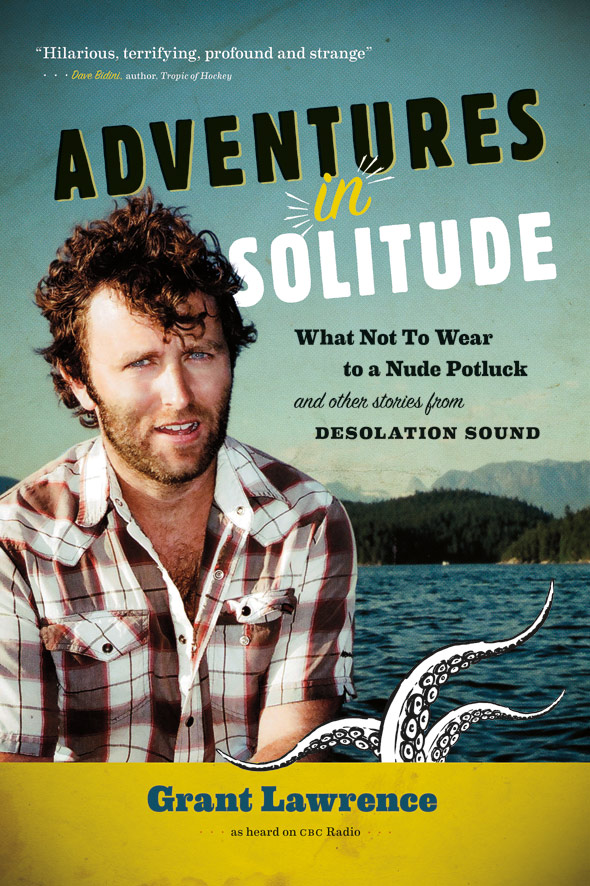
Adventures in Solitude

ADVENTURES IN SOLITUDE


- Grant Lawrence -


This book was funny! One of those rare books where the stories went from mental chuckles to laugh-out-loud (LOL) laughs. The few paragraphs about mullet clad Terry in his jean shorts (jorts), smoke in mouth, tubing behind the motor boat was so funny I reread the page four times, cracking up each time. The countless hilarious stories set a good natured tone throughout the book, but, there was so much more beyond the laughs. There was a much deeper story about Grant's life and the many changes he goes through. There is also a lot of history about the area (Desolation sound on the BC coast) expertly thrown in, used to enhance many of the stories Grant tells. There were also many touching parts where Grant removes his comedic facade and describes the natural beauty around him.


The book is centred around the the Lawrence family cabin. Grant's father, the outdoorsy type, buys a large tract of BC coastline with the intentions of developing it by building a bunch of cottages. The crazy part is that this land is located well beyond any road and is only accessible by boat. Saying it is remote is a bit of an understatement. Even with these formidable obstacles Grant's father manages to sell some cottages and build a cottage for the family as well. The first half of the book is a reaccount of Grant's childhood memories of the place. Grant was a self described 'nerd' without any interest in the outdoors. So, it is mostly made up of fish out of water stories as Grant encounters nature, the odd ball mountainmen, and hippies in the commune nearby. The first few trips up to the cabin are chock full of culture shock for Grant - which makes for great reading. At some points I found myself with the mixed feeling of laughing and pitying this poor 'nerd'. Luckily Grant makes it clear he is laughing at himself too as he looks back.


The book is divided into two parts. The second part is the adult life of Grant. In his young adult life Grant rebels against his family; stops going to the camp, tours the country with his rock band and lives the whole rocker lifestyle. For years he is absent from the cabin and Desolation Sound. After his band breaks up Grant finally concedes to a trip up to the Sound. This trip brings about a huge change, refilling Grant's soul and bringing him back to his roots (which he'd been trying to cut for years). Trips to the cabin became more frequent until he was pretty much living there for most of the year. It was inspiring to read Grant's remarks about the change the cabin was making on him. He went from cynical sounding ex-rocker to a self confident genuinely happy outdoorsman. This part two of the book accentuated his new found appreciation for the area and the lifestyle he had ridiculed for years. The stories in the second part change, focusing on the eccentric behaviours of the locals, the history of the area, and Grant's maturity. Strangely, I found the second part of this book better than the first; with much higher highs and lower lows. The stories had a different feel. They were just more raw. The funny parts were a bit cruder. The introspective parts laid it all out there and were borderline emotional.


The whole book ends wonderfully with Grant triumphing on life and all ending well.


Throughout the reading of the book I felt like I was actually on these journeys to the cabin. I'm not sure if it because of my own desire to own a remote cottage of my own. I'm betting, though, that it is mostly due to the fabulous writing of Grant Lawrence.

RATING : READ!


Another connection with recent books I've read. The early parts of this book Grant mentions reading Tin Tin books on the visits to the cabin. In Kitchen Confidential, Bourdain writes about reading Tin Tin books on his family vacations as well. I also recall Tin Tin books were my 'book' of choice for a few years in grade 3 or 4. Strange connection eh? Probably something all great writers do in their early years?


The Bourne Supremacy

The Bourne Supremacy


The second installment of the Bourne series is again full of action. However, the old proverb - about sequels never being as good as the original - is true.

Wordy! This book just has too many words. It could be a quick two or three hundred page fast movin' action packed paperback, instead of the 600 page mammoth it turned into. Now, there were many scenes that put you on the edge of your seat and kept you turning those 600 pages. There were the expected car chases, the identity changes, the occasional explosions and gun battles that I was expecting (and hoping for). But, there was also so much more...pages to read that is. Pages and pages of dialogue that seemed to drag on and on and on...like one of those phone messages you might get, you know that ones that time out they are so long...

Hey! Hello? Oh, you must not be home? Oh well, it's me. Me! Haha. Calling on my cell. I was calling to set up a meeting time. So, I'll leave a message I guess, haha. Call me on my cell and hopefully you will get me and won't have to leave a message and I won't have to call you back and leave a message haha. Anyway, again just had a moment so I thought I'd call. You know I forget sometimes, so when I do remember I just call. But, looks like you are not home...


You get the idea, a whole lot of blabbering, repeating, and droning on. At points while reading I wanted to yell at the book, "get to the point already! Or, at least move on to a car chase or something!"

I also found the entire storyline a bit too unbelievable, even for an over the top spy thriller. In this novel an assassin has been murdering top Hong Kong business men and diplomats, all the while leaving the calling card of Jason Bourne. The copy cat had to be stopped. The FBI/CIA guys get together and form a plan to motivate the real Jason Bourne to come out of retirement (aka witness protection program) and take on this killer. He is the only person in the world with enough skill to do it.

The plan is to kidnap his wife, whom you may remember as the tough as nails Canadian economist from the first novel? The plan goes a bit haywire after Marie escapes. Jason turns crazy thinking his wife is dead...all making great fodder for an explosive story. Unfortunately, the story gets bogged down with the long drawn out conversations between the government/FBI/CIA folks and the Hong Kong government guys. There conversations try to tell a bigger story about the Chinese wanting to cause a major crisis in Hong Kong so they can take it back over. However, there is a real chance this will turn into a something much bigger - WWIII!!

A big far fetched you say? I was lost too. After reading the 300 or so pages outlining the collapse of the East I was really bored, annoyed, and had eye strain. This, consequently, left me with the feeling that this book was really slow and not that good overall.

Another bone I have to pick with Ludlum is that error on Canadian geography! He writes that Marie is a tough ranch girl and their family has a ranch in Calgary. Makes sense, there are ranches out in Calgary. Calgary is in the province of Alberta which is wide open ranch country. Where the mistake comes up is that Ludlum keeps mentioning the ranch is in Ontario (not Alberta!) Every time he wrote something about Marie being a tough Ontario ranch girl I would cringe. I'm still left wondering how an editor did not catch something like this?

Rating: Do Not Read*

*Unless you are working on increasing your page count, let's say if you are in a contest such as 'who can read the most pages this month'.

Tuesday, May 17, 2011

Eastern Passage

EASTERN PASSAGE


I've read almost all of Farley Mowat's books...and he is always atop my list of favourite authors (he varies from first to third). I have a strange connection to his books, his life, even his view of the world. Like him I started life in Ontario then moved onto Saskatchewan and eventually returned. We have that Quinte Bay (Trenton & Belleville) connection. We have a similar interest in nature...and now Eastern passage has cemented this connection even further. I will elaborate: My dream job - writer. What I've been reading lately (and fantasizing about) - a magazine about living off the land, living off the grid, 'homesteading'. Strangely enough, this book starts out with those two things. It's FM's account of the beginning of his writing career, and as it turns out his homesteading experience...at the same time!


This book is just full of surprises. After his return from WWII, Farley meets up with France and gets married. This is a surprise to me since I've never heard of this lady. I didn't even know he was married? Anyway, FM can't stand the city (Toronto at the time) and manages to buy 10 acres from a friend for $50 or $500, don't quote me but it was cheap. The land in way out in the country, lot 4b on cty ln 10 off RR#30 just past the old burned out yurt...you get the idea? There is barely a road, there is no house, there is no electricity, not even cell phone coverage. Farley takes the spring and summer to put up what sounds like a solid log house. Made with his own hands, a shovel, and a jeep. The next year he takes on the land, which sounds like it was pretty worn out from previous logging and farming. He starts a giant garden, gets a few chickens, and starts reforesting the land. During these first couple of years he writes his first book - The People of the Deer - and sells a few magazine articles. His breakout success with this book brings more confidence and more ideas, pretty soon he has a few books on the go. One of these book ideas, eventually leading to And No Birds Sang, takes him and his wife on a European Vacation. Not the fun Griswold type (we're pigs), but, to reconnect with the battlegrounds and experiences he had during his war years. Then, to my surprise he starts a family?! Another shocker! I never knew he had kids? But, a little boy is born a year or so after the Europe trip. Then Farley promptly takes a voyage on a boat down the St.Lawrence river out to Nova Scotia, where the story suddenly ends. There is some foreshadowing that implies the trip was a bad idea and it would probably ruined his fragile marriage and new family life.


The book was laid out in an interesting way. Farley tells his writing story mostly through letters he had with his editor and his agent. Now, I know writers can be a bit strange and unconventional, but, Farley has to take the cake on this one. In most of his letters to his editor he writes very unprofessionally. He dismisses most of the changes his editor suggest (even if predicted to sell more books), which is normal I suppose. But, then mentions how he could write more if he wasn't always spending his time on that garden. How if he was just sent an advance, even $500, he wouldn't worry about him and his wife starving this winter. Or, he pushes that he should come meet with the editor, if of course they would kindly pay for travel food hotel. Then there are letters that he chats about the weather or some other topic that has nothing to do with writing. He rambles, he swears, he rants, he criticizes the government...in letters to his editor.


There seemed, to me at least, to be a theme running through the book - independence. Mowat shares stories about his homesteading, stressing how his eventual goal was to be self-sufficient. Then there is the a big section about a trip he takes to visit some old army friends who live in the northern part of Hastings county. These people were not part of mainstream society. They were living off the land; fishing and hunting. Farely's stories brought out the best in these rough outliers lives and I felt his tone bordered envy. Then there was his boat trip. What can be more blatantly isolating than being secluded on a boat in the middle of a large body of water...that's one way to get away, especially if there is a strong current pushing you. It was pretty clear by the end of the book that Farley was trying to get away from something at this part of his life. What? I'm not sure, but, that's what good writers do, leave you hanging...and/or encourage you to buy the next book! Or, leave you thinking? Was he running from his war memories? his wife? responsibility? growing up?


RATING: READ


As a post script/side note: I find it really weird when you are reading and obscure things pop up in multiple books. For eg. in Eastern Passage Farley rants about Jerusalem artichokes. Kind of an obscure thing to mention. Strangely enough, Jaime Oliver praises these things multiple times in The Return of the Naked chef. Weird, weird, weird. I have never heard of this 'vegetable' in my life, now all of the sudden they are in every other book I read!?


What even makes this even funnier is the passionate contrasting views on these artichokes. Mowat complains about how they are like weeds, they never die and just keep reproducing. He rages that they are almost inedible, look like a 'turd' and are probably just as nutritious!


Oliver, on the other hand, promotes these things as nutritious, delicious, elegant looking food that is underused.


Now, isn't that strange? Almost a Monty python moment - now for something completely different.


Friday, May 13, 2011

Kitchen Confidential

KITCHEN CONFIDENTIAL


Wow, is this book saucy! By that, I don't mean the one description of a great sounding chicken wing sauce, I mean the vulgar language, insults, rants, profanity, sexuality, blood, gore, drugs, dead pigs, rotten fish...you get the idea. Nobody under the age of say, 21, should be reading this, IMO.


Bordain uses his words like a chef uses his knife, to cut through all the bullsh** glamorized ideas that the food network cooking shows have given us (his insults on Emril & Rachel Ray are frequent and slightly funny). The world of the cook is not fun, easy, and thirty minutes...it's 18 hours, smelly, hot, sweaty, and well, working class! The book takes us into the culinary underbelly (as described by the cover of the book), and it kind of a frightening journey to tell you the truth.

In the preface, Bourdain states he only wrote this book for those in the industry, and truthfully thought nobody other than a handful of unemployed chefs/cooks with time to waste would read it...apparently it turned into a best seller? I can vouch for that; I would even buy it! Me, the guy who got mad over 70 cents worth of overdue library fines...it is that good.


This quasi-autobiography starts with a young Anthony travelling through France. He was a bratty kid, only eating hamburgers and french fries, shunning anything French. He was always a rebellious kid, which is what starts his food journey. It begins when the fam takes a day trip on an oyster fishing boat. Fresh oysters were offered up by the pirate like captain and nobody wanted to eat them (too weird, too slimy, etc). Anthony finally steps up and eats one, being the rebel of course. He loved it. From that point on he pushed the limits on all food, eating the strangest frenchest things on the menu.

Years later, on a summer break from college, he reluctantly takes a dishwashing job. It was that, or be evicted by his roommates. The restaurant he worked for was filled with crooked, drugged up, crude talking guys. Terrible sounding to me, but, paradise for Anthony.

It is incredible the outrageous stuff that went on in that kitchen was considered ok, even normal. There were lots of drugs, inter-employee 'relationships' (in the dry goods room!), bad food handling, gambling, stealing, just arrogant crass behaviour! And, the competitive atmosphere within the restaurant and with other restaurants down the street was mind boggling. The psychological assaults the cooks played on one other left me surprised that there were not any knife wielding incidents. The scary part - I think Bourdain toned down the stories. Your typical story teller enhances tales (ie makes stuff up). I think Anthony left much of the worst of it out. So, even as shocking as some of these stories are, I think there are worse ones left out.


The book is divided up like a fine meal. There is the autobiographical story of Anthony's career which makes up the entree - the real meat of the story. I say meat because any chef regards vegetarians as the bane of their existence, or at least Anthony does. There is also a side dish of stories about eccentric people Tony has worked with or worked for. This includes many junkies, megalomaniacs, and even the mafia. There are also small tidbits, appetizers and desserts, intermixed in the book. Mostly they are about how a restaurant actually works. You might get the impression these parts would have a textbook feel? Really, how interesting is it to describe what a porter does or how to order stock. But, instead of dry terminology and definitions Anthony gives us some tasteless examples of the criminal behaviour that he expects from porters (such as stealing food and booze). Some of the most effective parts of the book are these small dishes, effective in that they make you want to vomit. Like, why not to eat seafood on Monday. Or, why Sunday brunch should be called something like, 'stuff that should be going out in the trash but let's make a seafood fritatta out of it to save money'.


What I found this book did was bring me right into the noisy, hot, cuss filled kitchen and realize how much I've taken for granted being that diner who comes in for a relaxing meal on a Saturday night. But, other than make me feel guilty, Bourdain also does a great job of making the book relevant to anyone working in a cruddy job. Just like other jobs most of the time is spent in the drudgery of repetition ('the same dish 150 times a day' can easily be compared to 'the same data input into the computer 150 times a day'). Also the camaraderie of being on the same team, taking on the ever present enemy, be it the customer or the boss! The high point of this industry seems to be the personal satisfaction that comes with making a great dish (or 150 of them in a night). Anthony repeats many times that he often left work feeling satisfied deep down.


I do have to warn you, other than the three thousand foul words found in the book, that this is one of those books you are going to be quoting (hence, annoying others) for years to come. Most likely anytime you go out to eat you'll want to share some of your new found knowledge on the workings of the kitchen. Or, at least what NOT to order! Oh, and you'll probably never let anyone send anything back again, unless you like eating spit...or completely ruining the rest of the night for a few lowly cooks.


Overall, this was a book I didn't want to put down. It was a book I wished would go on forever. One of the best books I've read in years! I found the stories and writing just...entertaining on many different levels. The actual words Bourdain uses are all over the place, for eg. where is the last time you saw 'underbelly' used in a sentence? It's funny, which I like. It is also full of 'stuff' (words, phrases, life experiences) that I have never run across or for that matter ever hope to. This out of the ordinary 'stuff' is fascinating. Anthony's personal story, from lazy ass druggie to master chef, is so full of ups and downs you really never know what is going to happen next. So, get crakin'...readin'


RATING: READ


P.S. What made me first pick up this book was Anthony's shameless promotion of it on his great travel/food show No Reservations. Funny though, the jokes on Anthony - he promoted his book, which I got free from the library, from his show, which I also got free from the library...oh boy, I'm quite the cheapskate!