Monday, February 28, 2011

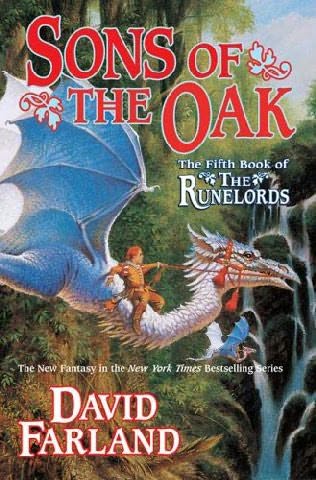
SONS OF THE OAK

Sons of the Oak


This is the fifth book in the Runelords series. One of those long drawn out fantasy epics. Thousands and thousands of pages, filled with far flung mythical ideas to make the mind escape into another world...which I guess is the point of most fantasy books? I'm going to throw a big disclaimer in here - This book is very far flung fantasy, maybe even 'hardcore' fantasy would be a good descriptions. I'll justify this point by giving you a quick rundown of the story; the Earth King dies, the evil demon Shadoath is back, the Son is a fireweaver, the forcibles are in sort supply, old souls are being reincarnated...'nuff said? To stress my previous point, you have to be really into fantasy to appreciate this one.


Luckily, I am into 'hardcore' fantasy. So, this book was a page turner for me.


You really need to read the first four books of the Runelords to get the full experience that is offered up in Sons of the Oak. If you recall, the previous books centred around a guy named Gaborn. This seemingly regular guy's destiny was to become the Earth King, which meant he could use the powers of nature to defeat evil. As I stated earlier - a far flung fantasy. Sons of the Oak turns the page on the Earth King novels and enters a new chapter, the life of his sons.


What big shoes those sons have to fill! If your father was the Earth King, the guy who saved the world from an eternity of darkness, how can you ever live up to that? This book explores that question. The books begins with a big battle scene. A gruesome extremely detailed battle scene. One, that even disturbed me...when there is descriptions of brains hanging out of heads, that are stuck to some knight's lance..that disturbs me a bit. After this action packed beginning the majority of the book is your typical journey/discovery story (I call it). You know? One of the characters journey halfway around the world to end up fighting the heartless, souless, evil villain. Along the way they discover their hidden mystical power, and eventually accept that it is their destiny to battle evil. In this case Fallion, the Earth King's first born, journeys to 'the ends of the earth' in an attempt to escape death. Along the way he discovers he can control fire. Luckily for him fire brings light, and evil heartless villians are controlled by 'darkness'...you can guess the ending by where I'm going here.


Even though many of the fantasy books I've read have very similar stories they never seem to get old. Take a look at the infamous fifty year old classic The Lord Of The Rings. What happens in this book? A young hobbit journeys halfway around the world and on the way there realizes he has some mystical power (in this case the ring) and that his destiny is to fight the darkness.


What makes this book different? There is an idea Farland calls 'endowments', where a mixture of magic and metal is used to transfer traits from one person to another. People can give up things like strengh, endurance, beauty, eyesight to another. The person taking these endowments can then have double the strength or double the eyesight of the common man. They are then called Runelords, hence the name of the book series. The good and bad points of endowments are examined in the books. Obviously there are some good points, like you can 'make' a super warrior to defend your kingdom. But, there are so many negative aspects. What happens to the people who give up their traits? Who cares for them? How far will someone go to get endowments...from children?


Overall, this book had a great story, lots of deeper ideas/theories to leave you pondering late into the night, some really gruesome scenes (if that is what you are into?), and best of all an ending that leaves you hanging...because there are more books! Gotta love finding a good series that has book after book.


RATING : READ

Wednesday, February 16, 2011

RESURRECTION MEN

Resurrection Men


When I classify my reading preferences I do not put myself in the mystery reader category, I always say I'm a fantasy reader. I have noticed that there are a few similarities between mystery readers and fantasy readers, most notably the volume of books. I'm confident in my opinion that fantasy readers tend to read a lot of fantasy books. I'm just as confident that mystery readers read a lot of mystery books. My proof - take a good look at the set up of your local book shop and you'll notice the large sections dedicated to mystery and fantasy (they are not mixed up in the general 'fiction' section).

Being in the fantasy camp, I have only dipped my toe in the ocean of mystery books. A few mediocre books is all I have read. This led me to think all 'mystery' gendered books were cheap, cheesy, cookie-cutter non-masterpieces. Having been around the block, or bookshelf, in the fantasy section I realize there are just as many cheap, cheesy, cookie-cutter fantasy books out there. So, a fantasy novice could easily stumble upon a few bad fantasies and write off the entire genre. It's as if you need a guide to lead you through the vast selection of books in the section. I was lucky, I had a guide who sent me towards Rankin...and since then I've polished off a few of his books with glee. This guide was a short term member of my now defunct bookclub who only chose one book and it was by Ian Rankin. He mentioned liking the detective 'Rebus' at one of our bookclub meeting and was met by blank stares (as the majority of the readers were fantasy readers). Who was this 'Rebus'? Well we were about to find out.

Rebus, a maverick in all ways. A police detective who works for the Scottish police in Edinburgh. He has a problem with authority and is often bending the rules to get things done. He is a copper who fraternizes with criminals on occasion, in seedy bars where he indulges in his massive drinking problem. His life is a mess. But, under this tough skinned exterior is a good cop, who always gets to the bottom of a case (typically a murder) no matter what it takes. He is that gruff character who you question the entire novel and end up applauding at the end. That is who 'Rebus' is.

In this book, Resurrection Men, Rebus is sent under cover internally to bust some corrupt officers. The only problem is Rebus does not have the best/cleanest past, so his previous cover ups are popping up all over the place...he could end up 'busting' himself in this process! I won't give much away by saying he eventually succeeds in getting these corrupt cops, but, it's an adventure getting there...and seeing how it all ends up (as in, who dies!).

The thing I like about Rankin books is all of the Scottish slang thrown in. You get a wonderful taste of Scottish culture and even the odd description of scenery (other than the inside of a bar). There are great explanations on how Scots are different than the English, which ignorant me didn't know anything about...what? They all live on the same island right? What really surprised me was how much instant coffee they drink.

My only concern with this book was the number of characters. There were just too many; Rebus and his 'sidekick' Siobhan of course, then a few murder victims from the cases they are working on, four or five co-workers, then the suspects which number a few, then the handful of underworld denizen (snitches, gangster leaders, prostitutes etc). This tactic of using a lot of characters is a double edged sword. On the one side, there are lots of characters that can be used in a variety of different ways to further the story along or make it that much deeper (and hence, a more fulfilling read). On the other hand, keeping track of thirty names can get kind of confusing, especially when you have an ignorant reader like me that keeps mixing up city names with people's names. So, this is not a book to read in short burst or when you are very tired. It is best to set aside some quality time and make an effort to concentrate on memorizing all the names.

Rating: READ

Friday, February 11, 2011

EAT THE RICH

Eat The Rich


- P.J. O'Rourke -


This is a book that I keep hearing about. I first ran across mention of this book while reading some random article about 'the best humour books' that came across my webfeed thingy on the top of my email (at work I might add...I read it on my lunchbreak ok?). Then it turns out to be February's bookclub book on the BBC's radio program The Strand. So, I instantly went to the library's website and looked it up...yes! It was in! I could start my humourous journey through the world of economics. Yes, I'm that dorky!


Just before starting this book I read through an issue of MAD magazine. Remember MAD? Well, our library has a few copies, they are in the basement in the 'teen' section...yes, I'll admit it, I was wandering through the teen section, but, I like to make full use of all areas of the library. Funny though, I should read MAD and then start Eat the Rich. They are strikingly similar. Both are satires to the extreme...and in fact, I wouldn't be surprised in the least if O'Rourke was a writer for MAD.


Back to the world of economics in Eat the Rich. O'Rourke dishes out a very tongue-in-cheek summary on the basic theories of economics. You may be familiar with a few; supply & demand etc. Being a business major in university I had the joy of taking the required micro/macro economics for years so I found this sarcastic view of economics very funny. As for the non-business minded people - you won't understand a thing. When he starts into the theory of comparative advantages I'm sure all you'll get is that he is insulting John Grisham and Courtney Love through a chart somehow! Actually, this is only one small section that is laid out like a textbook with graphs and charts (this is the part that made me think of MAD the most) which look almost exactly like my first year econ book. O'rourke's charts end up making funny jokes like point B and point S make BS (haha). This is funny, but, I have a real world example that made this even funnier. In my first year econ we had a 'cool' prof. She let us have cheat sheets, told us exactly what was going to be on the exam, and get this : she made charts with the supply/demand curves for funny things likes smokes and booze! How cool was she!?


PJ also takes us on a trip through the world looking at different economies to try and figure out which one is the best. Being an American seems to have tainted his vision a bit, er a lot. His travels consist of criticizing the country he is visiting and slyly comparing it to the overwhelming success (his opinion) of the US. The only positive visit he had was to Wall Street! He thought those screaming/rushing/greedy stockbrokers were just wonderful guys. The polite reasonable citizens of Sweden did nothing for him. In fact, their generous 'welfare' state benefits (like maternity leave) were almost criminal in his mind. How can a country just pay people to 'not work'? Then he berates their high taxes and their word/philosophy 'lagom' (which means something similar to 'just enough', as in not greedy not impoverished just good...er just click the link). From the ol' capitalist point of view I can see his argument that money in the US may make more profit than that in Sweden...but, strangely he completely left out any of those surveys/rankings that put quality of life in Sweden in the top few countries, while his precious US always hovers around the double digits. There is a lot more to life than money O'Rourke! Ok, enough with my soap box speech back to the book.

There were a few good points to the book. The wide range of vocabulary PJ uses is astounding. He sent me searching through my dictionary a couple of times - per page! Unfortunately, many times the word did not show up. I guess many of his words were quasi-fictitious words, as in understandable but not dictionary-worthy (see I can make up words too!). Even with all these rarely used words, in a veiled attempt to confuse the reader, the writing was clear.

Now onto the 'bad' parts. How about we start with O'Rourke's remarks about Canadians? The only mention about Canadians in this book is when PJ is visiting Cuba strangely enough. While explaining the tourist industry in Cuba he throws some off-colour remark about the only visitors seem to be Canadians who's idea of a good time is visiting the all-you-can-eat salad bar for seconds. How insulting! Even before this hurtful comment I noticed the book had a very negative tone. Most of the 'witty' comments/jokes were just blatant insults of other countries.

I did manage to catch part of the BBC's bookclub when they had their interview with O'Rourke and I was a bit taken back. He sounded nice! No insults, no negative comments...in fact, he said he felt very positive about the future of the world, even after the 'economic meltdown' in the US. It was a complete 180 from his writing in Eat the Rich!

Rating: DO NOT READ*

*Only read if you have run out of MAD magazines and want to hear more American-centric world views...and it helps if you have a degree in Economics and can catch the subtle econ-jokes.

Thursday, February 10, 2011

THE HOUSEKEEPER AND THE PROFESSOR

The Housekeeper and the Professor


This book came to me via Jen, or more specifically her bookclub. It's a smallish book, so when Jen finished it quickly, said it was good, and left it lying about...well, I had to read it. Right?
If you google this book a ton of reviews come up and a majority of them, to my surprise, use the exact same description - CHARMING. And, it's true. This book is a charming book.
Ogawa does a great job of blending a simple story, about a Japanese housekeeper forming a friendship with her employer the professor, with quirky facts about math. This book follows a well used story line, where you have two people who have trouble forming a relationship because of some strange reason/problem. In this case, the professor only has 80 minutes worth of short term memory and cannot remember anything past 1978. So, every morning when the housekeeper comes over it is like they are meeting for the very first time (hmm, 50 first dates anyone?).


What I found interesting right off the bat, and I don't know if this was Ogawa's intention, is that these two characters seemed to be both social outcasts in a way. From what little I know of Japanese culture outward appearance is very very very important. The housekeeper, whom had a baby when she was a teen and is now a single mother, and the Professor, who is covered in scraps of paper he attaches to his old suit to jog his memory, both seem to be on the outs with society's expectations.

After we get into the book a bit we find the professor is a genius in math. He can find the most fascinating facts about any number; shoe size, phone number, IQ? And, he has a way of explaining the most advanced math theories in simple language that we can all understand. This math obsession brings a lot to the book. First, it brings up some interesting/fun math facts. Two, it make this book more interesting than a story strictly about a relationship (blah). Three, it gives me something to think about outside of the book. I found myself thinking about this math genius and how it was so interesting that he could have all of this math knowledge stored up in his brain. I wondered how much time he has spent working with numbers? How ones brain could concentrate on something like that for so long? What makes a brain be able to do that? I found I was a bit jealous knowing I'd never be that knowledgeable about one subject. Then I thought about how sad it was that he was so obsessed with numbers. How he seemed to lack social skills, and any kind of life outside numbers. He had no other domestic skills, not even basic cooking or cleaning. His whole life was wrapped up in thinking about numbers. Even his small interest in baseball was only there because of all the stats and numbers. I thought the baseball story line just accentuated how much the professor was like a kid in many ways. It was almost like the housekeeper was taking care of two kids?


However, the way the professor worked with numbers made you just want to meet him. I just wanted to throw a random number at him and see what he could make with it. He was a lovable character who came across with a good heart. He seemed to make the most out of his life and rarely let his 80 minute memory get him down. The housekeeper seemed to be a good hearted character as well, with tireless energy making everyone else's life happy and clean.
There seemed to be no 'villain' in this book. I was half expecting a rival mathematician to show up one day and have an algebra dual just to add some action to this book. But, alas no evil math wizard showed up. We are just left with the stresses of everyday life to add climaxes to the story.


I'll gladly repeat what many others have said before me, this book is charming.

RATING: READ

Saturday, January 8, 2011

METATROPOLIS

METATROPOLIS


- John Scalzi -
(Jay Lake, Tobias S. Buckell, Elizabeth Bear, Karl Schroeder)


I saw this book on display at the library on the 'new sci-fi/fantasy books' and ended up taking it out. This was definitely an 'impulse buy', if that is possible to do at the library? I was rushing through picking up something else, on my lunch break, and I just happened to be walking by the 'new books' display (which seems to happen every time I'm there). I was not in need of a book since I was still only halfway through The Bourne Identity, but, I picked this book up anyway. Just to glance at it of course. What interested me was the self labelling on the front cover - A collection of stores in a shared future...yes, now seeing that in print I realize it's a bit weird to find that interesting. But, I really like books that take a look at the world in the near future, especially those horribly depressing post apocalyptic ones!
Looking this book over I realized this book had a couple of things against it, at least in my eyes. One, it was not a book about a post apocalyptic world, which I initially thought it was because of the cover art. Two, it is a collection of short stories...I don't typically read collections of short stories, I prefer the long drawn out epic trilogies of at least 1800 pages. Even though I think I prefer epics, the two books of shorts stories I have read in the past have stuck with me, and I enjoyed them and I think about them from time to time. Anyway, I gave into my impulse to 'impulse buy' and borrowed the book.

The five stories are all good enough to be stand alone short stories, but, together they create something more. The writers all do a great job of interlacing their individual stories with all of the other ones in the book. For eg. there is a constant contracted security force called Edgewater that makes an appearance in each story. Many of the new gadgets of the future make their way into multiple stories (like the 3D glasses). There is also mention of the other stories and cities the other writers use. These all help congeal the book, bringing it all together like a nice jam. One story is like the sugar, another like the strawberries...although good on their own when mixed together to make they can make much more...like a nice jam, mmm.
I know the question you are asking, which story was the pectin - not tasty, but, needed to hold the mixture together?


Even though the stories all revolve around a similar future world and have a focus on exploring what cities will be like, all of the stories have drastically different feels. The major difference is the writing. All of these writers have different styles and putting them back to back really shows this off. I have to say Jay Lake's writing style; straight forward, very simple, short sentences, small paragraphs, was a the one I enjoyed reading the best. This was the first story in the book, so it grabbed my interest and created that positive feeling right off the bat encouraging me to keep turning those pages. I'm glad the book started with that story.


The first story, In The Forest Of The Night, took a look at a city built by environmentalists. Imagine how a city of extreme 'tree huggers' would look, function, and survive. Well, Jay Lake, thinks it would be found in the deep forests on the Pacific west coast. It would be hard to find since the citizens would be very conscious of the land and do all they can to prevent harming it. These people would be spread out, and very little government would exist. They would be self sufficient and eat fungus and stuff they grew in the trees (yum). It kind of reminds me of the many fantasy books I've read and the elves. Elves have cities in the forest, that blend right in. They somehow keep in balance with nature and cause no ill effects.


The next story, Stochasti-City, by Tobias S. Buckell, looks at how Detroit might fare in the future. With sky rocketing oil prices and a ruined economy, it seem many people are getting desperate for jobs. 'Turked', is the key word here. Turked, is taking a small job that is posted on the web, some job like - take this unmarked bag to a corner three blocks from here and drop it in the mail box. Obviously some illegal smuggling or something, but, when there is no work people get desperate. The main character takes one of these 'turked' jobs, which is to watch a security compound and text a message everytime the security officers come out. He ends up not getting paid so he tracks down the people who were supposed to pay him. Turns out it is a gang of bikers, not motor bikes (what with the cost of oil and all), but bicycle riders. Who are also extreme environmental activists. They take over abandoned skyscrapers and turn them into farms/greenhouses. They travel across the country doing this. I guess this appeals to the main character and he ends up joining them and has a much more fullfilling life. No more 'turking'.

The third story, The Red In The Sky Is Our Blood, Elizabeth Bear, is also set in Detroit. It is another story with a bicycle. A hardened biker chick is recruited by a secret society (I guess the another idea of an alternate city of sorts) who live in the former suburbs. All of the houses are abandoned, so this secret society salvages stuff to make them into greenhouses. This book has the feeling of a public service announcement/survival guide. It talks all about how landfills are filled with so much stuff that if we scavenged it all out we could live a mighty fine life, and lack nothing. I found it kind of preachy and the story line was lacking...even for a short story. If I were grading this I'd give it a D- . Which is kind of sad b/c I've read Elizabeth Bear novels and liked them.
This story may be the pectin I was talking about earlier.

The fourth story, Utere Nihil Non Extra Quiritationem Suis, by the editor John Scalzi, is a bit of a lighter story. It starts and ends with a pig in a wedding picture. This one takes place inside a new St. Louis. It's a closed city where the economy strictly managed. The main character is a slacker who finally comes of age where he either has to work or leave the relative safety of the new city. However, since he waited so long and never took school seriously he is left with a position working in a skyscraper pig farm. Lucky guy!
In the end he goes from a kid on the edge of society, not connected and not involved, to find his place in society. This one had a slightly more positive look at how efficient cities could be in the future...even if they are surrounded by chaos.

Final story, To Hie From Far Cilenia, by Karl Schroeder, is the only story that takes a peek into a far flung idea for a future city. The idea is a virtual city 'made' from online gamers. It sounds like they put on these special glasses that change the way the world looks. Buildings are given an old world feel, people's clothes have the look of the early 20th century, and other's with the glasses in the same world are highlighted. It sounds like the more you put into this world the more access you get, and eventually can move onto deeper and deeper worlds. They are hidden cities, functioning apart from 'reality'. There are restaurants only members can get it, with food grown by other 'members', all living in buildings for 'members' only. Very complex...in fact, a little too complex for me to really follow. This may have been better in novel length?

What was missing for me...a future city on the moon!

Overall, I felt kind of depressed reading these prophecies of our future. Where has the happiness gone? Where was the hope of a brighter future? Where has the dream of space travel gone? Maybe I'll look for a brighter book on my next visit to the library.

Rating: READ

Thursday, December 23, 2010

FAT BALD JEFF

FAT BALD JEFF

- Leslie Stella -


I believe this was one of many books I obtained at an auction/barn sale. Fill a box with books for $5 allows you to grab books you'd never buy at a bookshop (even a used bookshop). This one has a laughable cover which, for some odd reason, appealed to me. A quick glance at the back cover description sold me. The five second skim told me this book was a humorous look at life in the office. Well, I work in an office, I enjoyed the few episodes of The Office I have watched, and the movie Office Space makes me crack up.
I will say this book was an easy read, as in not a whole lot of substance. Which, can sometimes be a good thing; when you're tired and don't want to get into something complicated for instance. This is not a book that will keep you up until the wee hours of the morning. That said, there were a few parts I did find very funny. The beginning was kind of reminiscent of the Shopoholic series (Kinsella). There were a few common laughs; mostly the over dramatic letters conversations, and the wacky obsession with fashion. I was hoping for more office politic jokes though. There were a few doozies in the beginning of the book, but, they soon fizzled out. I also had a problem relating to the main character - a self absorbed, elitist, fashion disaster, whiny, & erratic...which strangely, are qualities that could make a wonderful character. It just never panned out for me.

The main story line was plausible. A couple of disgruntled workers pull a 'wikileaks' and post some embarrassing pictures and expense reports showing how sleazy and corrupt the management and executives are. These two mavericks are successful in causing a lot of chaos, and a choice boss to get fired. But, they do not end up better people for it...sadly.

For all the cubicle citizens out there, this scenario sounds like a daydream, especially around evaluation/pay raise/bonus/the day you run out of vacation, but, again there was not a lot of substance in the story. It wasn't awful. It wasn't a bad read. It's not that is was unbelievable...there was just no build up, no big shocking climax. There were just a few chuckles here and there.

There were a few side stories, attempts to paint a picture of our protagonist and her common (yet, sadly depressing) life. Her thrift store treasures, her cramped apartment on the rough side of town, her dysfunctional relationships with her mother, roommate, boyfriend, pretty much everyone she comes into contact with. I did enjoy the stories of her upbringing. They consisted of short memories revolving around her hippie parents and how their parenting choices made her the whining, disgruntled person she is. What I found hilarious was the many 'crazy' things her parents did were things I agree with and do in my own life. The 'weird' food her mother made her eat - organic leafy things. No processed hotdogs for her. The homemade toys, the dolls without faces. No Dora or Disney either. This was the only part of the book that made me think; am I creating a monster like this disgruntled employee? Maybe, I should save this book and reread it in 20 years and compare...I have a feeling I'll be ok.

My rating: Do Not Read*

*Unless you get this book in a $5 fill a box (a big box at that) AND you are a disgruntled employee who constantly dreams of overthrowing your current cubicle world...then again, you might be better off spending the three hours it would take you to read the book daydreaming about your own cubicle revenge.

Book Club Questions:

1) What is your ultimate office daydream?

2) Is the main character believable? Who has that many temper tantrums past the age of 2?

3) What is up with the mustache obsession?

If you have any additional bookclub questions feel free to comment and I may add them.

Tuesday, December 21, 2010

THE BOURNE IDENTITY

THE BOURNE IDENTITY

-Robert Ludlum-


This was another book I casually tossed into a box at an auction/barn sale. $5 to fill a box with books makes you prone to grabbing anything that looks the least bit interesting or a book you may have heard of at some point in your life. The Bourne Identity was one of those titles I had heard of, from the blockbuster movie...apparently they were based on these books? I have not seen the movie yet, but I've always wanted to. So, what better way to experience the movie than to read the book. As anyone who reads a lot knows - the book is always better than the movie! Anyway, this name recognition was what made me pick up this book; I'm so glad I did.

I try and give a book 100 pages or so before I give up on it. I'll say, I had no problem reaching 100 on this one. It has taken me a bit longer than usual to reach page 100 for a couple of reasons. One, it is almost Xmas so my reading time has drastically decreased due to the demands of the season, and B) I find I have to really concentrate; read every word. No skimming in this book. I found in a few places the action was so fast paced, things changed in the blink of an eye, if I speed read a paragraph (even a sentence in some cases), I'm was lost. I had to backtrack to find how we got to this brand new place. It really showed how lazy I reader I must be, how often I glaze over words...what else have I been missing?

I have read a couple of similar action packed 'spy' novels, but, this one has far exceeded them all (which racks up to at least a dozen or so). There were countless surprises and shocks, but, intermixed was the logic that made it all believable. Ludlum throws a few small nuggets of information in brief conversations that later come back to explain otherwise unbelievable situations. A small example would be Bourne making the mistake of casually mentioning to his trustworthy banker that his stay in Zurich was nice, especially the view from his room overlooking a lake. Later on the when the goons, who are out to kill him, show up at his hotel Ludlum brings back that conversation about the hotel overlooking the lake. Since there are only a couple of hotels overlooking a lake it seems plausible that he could have been found. The small details like this keep me the reader engaged in the story. Furthermore, making me keep tabs myself on what's being said and who's saying it. I find I get deeper and deeper into the deception and mystery the more I read, the more I thought about it. The book was full of twists and turns, big and small, that made me want to keep chugging through the pages.

The story is centred around Jason Bourne. He takes a bullet in the head and it injures his brain, leading to amnesia. Are you thinking, haha that amnesia story line is used so often in sitcoms for cheap laughs? Not a laughing matter in this book. I found instead of making me laugh it took me in, took me on the journey with Bourne as he tried to find himself...it really added to the plot of deception and lies because you really had no idea what should happen. As in, who are the 'good' guys, who are the 'bad' guys. It really worked with this type of thriller plot. Back to the story, Bourne goes from knowing nothing about himself to finding out he has some hidden talents and instincts that seem to be of a darker nature - crime, fighting, manipulation...even killing! He has a wild journey through Europe (aren't the best thriller novels set in Europe?) finding out about hidden Swiss bank accounts, assassination plots, and his talent for getting out of near death situations. For a good chunk of the first section of the book he is being chased by mysterious thugs out to kill him. This goes on for pages and pages, at around page 100 he has been shot 8 or 10 times and is on the verge of death. Luckily for him there is a kind hearted Canadian there to save him!

Yes, I said Canadian! You have to love it when an international spy novel has a Canuck playing a major role. In reality though, this character was used as a convenient hostage and human shield by Bourne and put in many dangerous situations. This character should be traumatized for life after this, BUT, bless her heart this caring Canadian rescues Bourne from certain death as he lay bleeding out on the street. She helps even though she was beaten, abused, and on the verge of being executed herself all because Bourne kidnapped her. Ah, good ol' Canadian. If you are sensing a love story forming you may be right...which is the part of the book I find completely ridiculous! But, I'm willing to overlook this for a couple of reasons. One, the rest of the book is mind blowing, and B) Ludlum picked a Canadian over every other nationality in the world.

After the initial mad rush of page after page of action packed chasing and shooting the book slows down a little. The middle section of the book is where Bourne starts piecing together his true identity. Although there is not as much heart pumping action, and Bourne does not get shot anymore, the page turning desire does not cease. Clue after clue leads Bourne towards finding out who he is, where he is from, and why it seem the entire underworld is out to get him. This is where the amnesia plot plays a key role. As Bourne gathers all of these clues we, the reader, are piecing everything together with him...in one way, it's almost like we are Bourne. Then we are given a shocker, a clue that Bourne does not know. This information changes our whole perspective on the story - on who Bourne is and why it seems everyone is trying to kill him.

The last section of the book is the climax, which means lots of suspense and action. All of the loose ends are tied up and we are all led to the same conclusion as to who Jason Bourne really is. Then in the last dozen pages the hero (Bourne) and the villain (Carlos) square off. Bourne is shot again and Carlos gets away. This is the ideal ending because it leaves everything open...I'm left wanting, desiring, craving the next book! Thank you very much Ludlum, I didn't get the Bourne Supremacy - the next installment of this series - in my $5 box of books.

I mentioned earlier that I thought reading the book would be better than watching the movie. I'm sure there are many out there that argue maybe in this case watching the movie, with all it's special effects, might add to the action. But, I find I've taken so much time reading this book that I've gotten so much out of it. Instead of all the small details of the plot and mystery being condensed into a couple of hours I've managed to stretch this out for weeks. I've spent hours and hours reading and thinking about the book...which I think makes for a better overall experience.

Rating: READ!

Book Club Questions:
  • If you had amnesia what instincts would show up for you?
  • Swiss banks. Ever been to one? You think they are really that cold and secretive?
  • Is the action believable to you? For eg, getting shot 10 times in many different occasions in one night and living to tell about it! Is the writing so strong that this doubt never crosses your mind.
  • This book was written 30 years ago. Other than the lack of internet and cell phones, does the plot and story seem relevant in today's world?